Last updated: October 26, 2026. This is a general guide, not legal or tax advice. Rules (especially on the definition of wages) are still being finalised under the new labour codes, so confirm with your CA or legal adviser before fixing a structure.
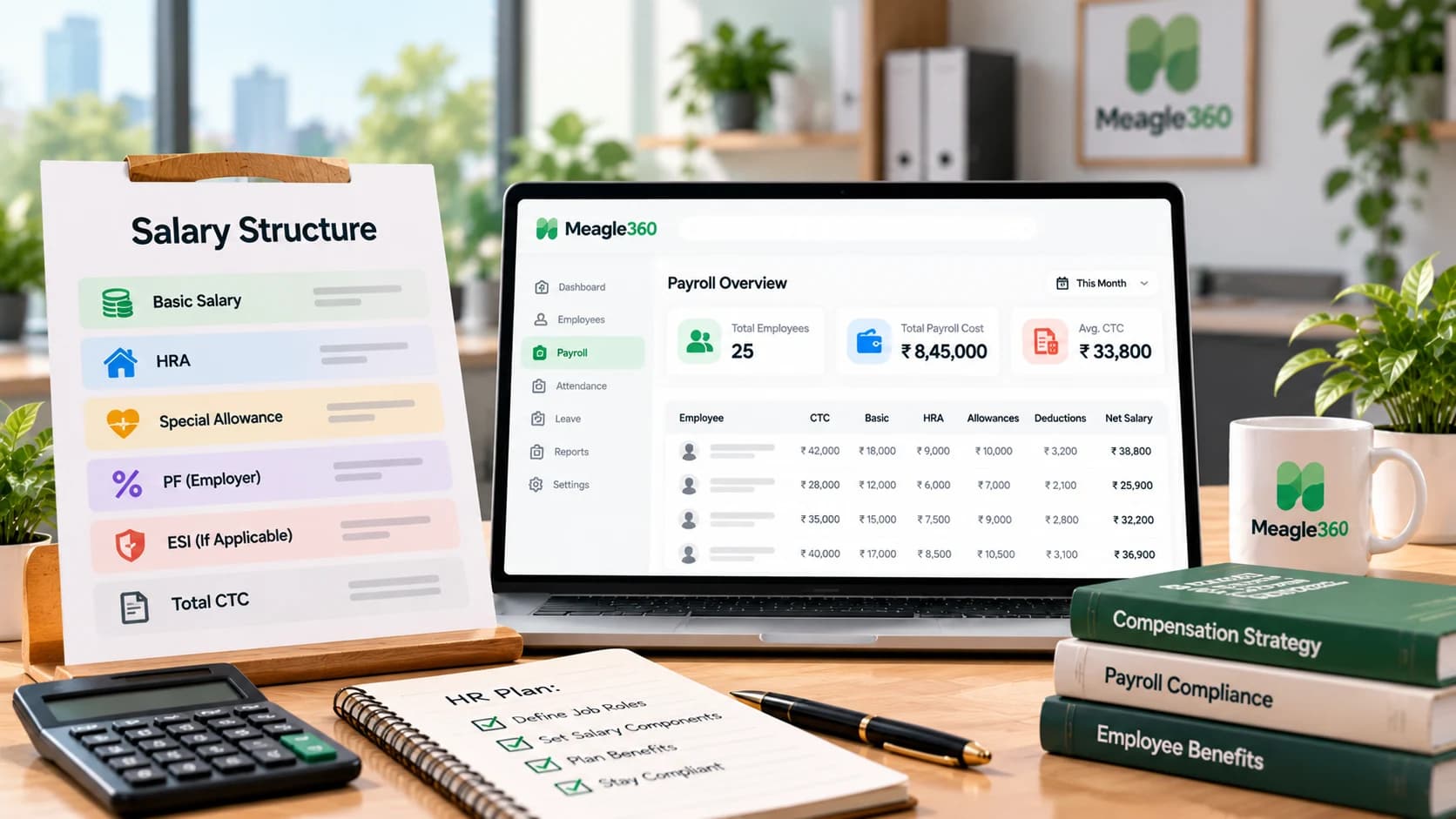
A good salary structure splits CTC into a few clear parts: Basic (about 40 to 50 percent of CTC), HRA, a special allowance that balances the total, and the employer's PF and gratuity. Keep it to 4 to 6 components, make sure the numbers add up to CTC, and document it in the offer letter.
Most small companies copy a structure from the last employer, then discover it causes payroll errors, unhappy employees or compliance problems. This guide shows how to design one on purpose.
The Building Blocks of a Salary Structure
| Component | What it is | How it is usually set |
|---|---|---|
| Basic | The fixed core of pay | About 40 to 50 percent of CTC (see the 50 percent note below) |
| HRA | House rent allowance | Commonly 40 to 50 percent of basic |
| Special allowance | The balancing amount after fixed components | CTC minus everything else |
| Employer PF | Employer's contribution to provident fund | 12 percent of PF wage (basic, subject to your PF policy) |
| Gratuity | Accrued for service of 5 years or more | About 4.81 percent of basic |
| Variable pay or bonus | Performance or festival pay | Fixed share of CTC, paid on conditions |
| Employer ESI | Only if gross pay is within the ESI limit | 3.25 percent of gross pay |
Not every component applies to every employee. A simple structure is easier to run and explain.
Step 1: Decide the Goal
Before choosing percentages, answer three questions:
- Who is this for? Juniors, seniors, sales? A sales team may need a variable component, support staff usually do not.
- What matters more: take-home or retirement savings? A lower basic increases monthly take-home but lowers PF and gratuity.
- How many people will use it? If you have 10 employees, one structure may be enough. At 30, you may want two or three bands.
Step 2: Fix the Basic First
Basic drives almost everything: PF, gratuity, HRA and often leave encashment. Common practice is 40 to 50 percent of CTC.
The 50 percent note: under India's Code on Wages, the definition of "wages" is meant to include basic and certain other pay, and allowances above 50 percent of total remuneration are added back for calculating wages. Practically, this pushes companies towards a basic of around 50 percent of CTC. The rules are still being finalised, so confirm how it applies to your business with a CA or legal adviser.
Step 3: Set HRA
Common practice is 40 percent of basic (non-metro) or 50 percent of basic (metro). Note that:
- HRA exemption is available only under the old tax regime. Under the new regime (the default), employees do not get an HRA exemption.
- HRA should not be so low that it looks like a token amount, or so high that it forces an unnaturally high CTC.
Step 4: Add Employer Contributions
- Employer PF: 12 percent of PF wage. Many companies cap the PF wage at ₹15,000 per month (a maximum of ₹1,800 each for employer and employee). Others calculate PF on actual basic. Choose one policy and apply it to everyone consistently.
- Gratuity: accrued at about 4.81 percent of basic (15 days of basic per year of service, divided by 26 working days, divided by 12 months). It is part of CTC but paid only when the employee becomes eligible.
- ESI: applies only when gross monthly pay is within the ESI limit (₹21,000 per month). Above that, no ESI.
Step 5: Let the Special Allowance Balance the Total
Special allowance is whatever remains after all the fixed parts:
Special allowance = CTC − (Basic + HRA + Employer PF + Gratuity + Variable + other fixed parts)
It is flexible and taxable, so it is where you adjust monthly pay without changing PF and gratuity.
Worked Example: ₹6,00,000 CTC (₹50,000 per Month)
Assumptions: basic is 50 percent of CTC, HRA is 40 percent of basic, employer PF is 12 percent of actual basic (no ceiling), gratuity is 4.81 percent of basic, no variable pay, no ESI (gross is above ₹21,000).
| Component | Monthly (₹) | Yearly (₹) |
|---|---|---|
| Basic | 25,000 | 3,00,000 |
| HRA (40% of basic) | 10,000 | 1,20,000 |
| Employer PF (12% of basic) | 3,000 | 36,000 |
| Gratuity (4.81% of basic) | 1,203 | 14,436 |
| Special allowance (balance) | 10,797 | 1,29,564 |
| Total CTC | 50,000 | 6,00,000 |
Gross monthly pay (Basic + HRA + Special allowance): 25,000 + 10,000 + 10,797 = ₹45,797
Employee deductions: employee PF (12% of basic) = ₹3,000
Take-home before income tax and professional tax: 45,797 − 3,000 = ₹42,797 per month
Employer PF and gratuity are part of CTC but are not paid out monthly, which is why take-home is lower than CTC. For the full picture see CTC vs in-hand salary and gross vs net salary.
Try your own CTC numbers: CTC to in-hand salary calculator
What Changes if You Lower the Basic?
Same ₹6,00,000 CTC, but basic set at 30 percent of CTC (₹15,000 per month), with the same assumptions.
| Component | Monthly (₹) |
|---|---|
| Basic | 15,000 |
| HRA (40% of basic) | 6,000 |
| Employer PF (12% of basic) | 1,800 |
| Gratuity (4.81% of basic) | 722 |
| Special allowance (balance) | 26,478 |
| Total CTC | 50,000 |
Gross monthly pay: 15,000 + 6,000 + 26,478 = ₹47,478
Employee PF: ₹1,800
Take-home before tax and PT: 47,478 − 1,800 = ₹45,678 per month
| Basic 50% | Basic 30% | |
|---|---|---|
| Monthly take-home (before tax and PT) | ₹42,797 | ₹45,678 |
| Employer plus employee PF per month | ₹6,000 | ₹3,600 |
| Gratuity accrual per month | ₹1,203 | ₹722 |
The trade-off: the lower basic gives about ₹2,881 more in monthly take-home, but less goes to PF and gratuity, and it may not satisfy the 50 percent consideration under the Code on Wages. Employees who understand this often prefer the higher basic for long-term savings. Decide on purpose, and explain it to employees.
Common Mistakes When Designing a Salary Structure
- Too many components. Ten allowances make payroll slow and error-prone.
- Very low basic to inflate take-home. It reduces PF and gratuity and can create compliance problems.
- No written policy. Two employees at the same CTC end up with different structures.
- Ignoring PF policy. Using the ceiling for some employees and actual basic for others invites questions and disputes.
- Forgetting ESI. Employees with gross pay near the ESI limit need different handling.
- Not testing the numbers. Always check that components add up to CTC and that take-home is realistic.
- Not updating it. Review the structure when labour rules change or when you cross an employee-count threshold.
How to Put It Into Practice in 5 Steps
- Pick your component list (Basic, HRA, Special allowance, Employer PF, Gratuity, plus variable if needed).
- Fix the percentages for each salary band.
- Test 3 sample CTCs with the CTC to in-hand calculator.
- Write the structure into your offer and appointment letters. See our offer letter template and appointment letter template.
- Set the same structure in your payroll system so every payslip follows it. See payslip format.
Setting up a salary structure is one thing. Running it correctly every month is another. Meagle 360 applies your structure to every employee, calculates PF, ESI and TDS and generates payslips from attendance data. Book a free demo