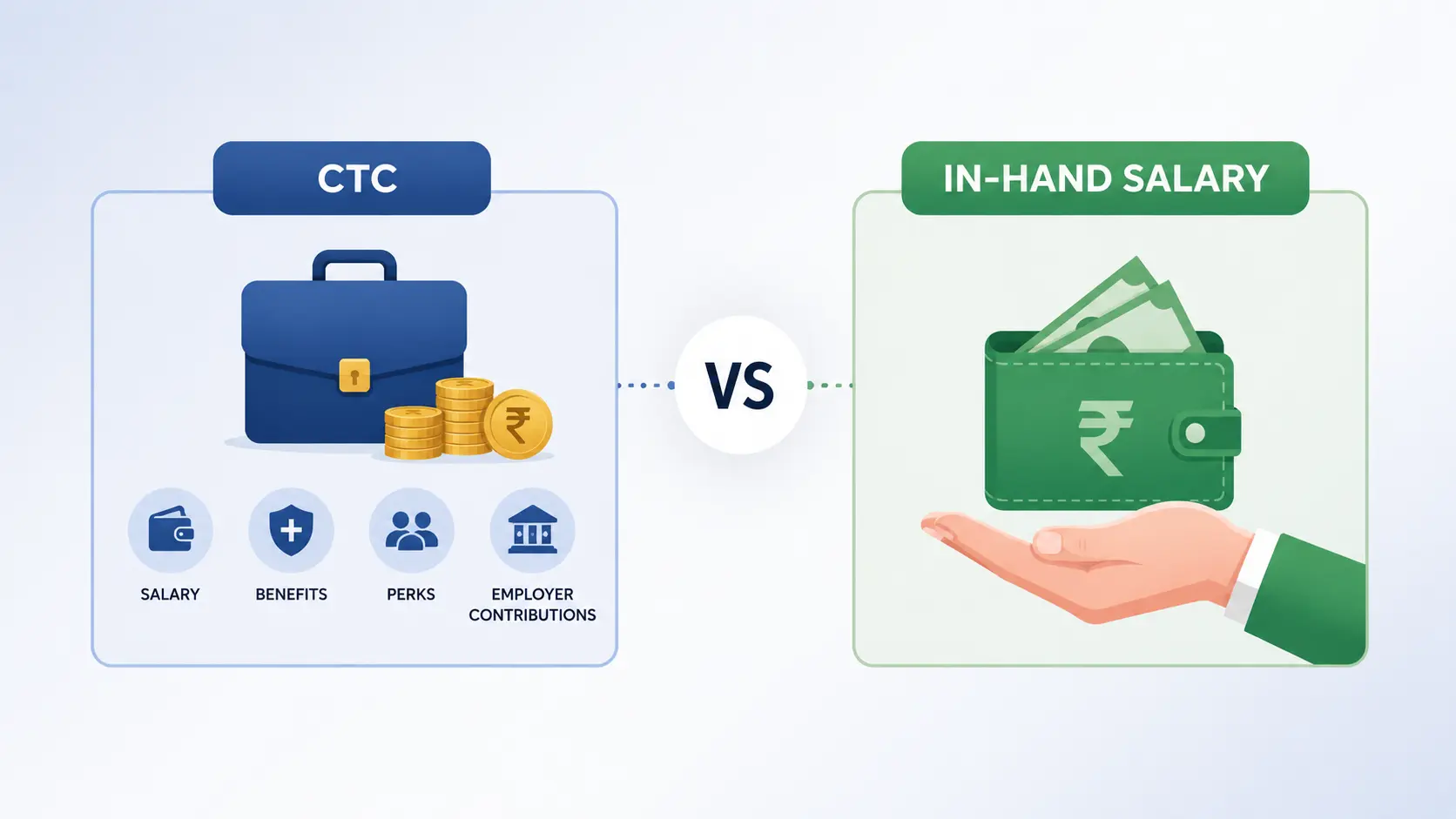
CTC (Cost to Company) is the total amount a company spends on an employee annually, including salary, benefits, and employer contributions — while in-hand salary is the actual amount credited to the employee's bank account each month, after deductions like PF, professional tax, and TDS. The gap between the two is one of the most common sources of confusion when comparing job offers.
What Is CTC?
CTC stands for Cost to Company — the full annual cost an employer bears for an employee. It includes:
- Basic Salary
- HRA (House Rent Allowance)
- Special Allowances
- Employer's PF contribution
- Employer's ESI/insurance contribution
- Gratuity (accrued, not paid monthly)
- Performance bonus (if fixed/guaranteed)
- Other benefits (meal cards, LTA, etc.)
What Is In-Hand Salary?
In-hand salary, also called take-home salary or net salary, is what actually lands in your bank account every month, after all deductions:
In-Hand Salary = Gross Monthly Salary - (Employee PF + Professional Tax + TDS + Other Deductions)
CTC vs In-Hand Salary: Full Breakdown Example
Let's break down a ₹9,00,000 annual CTC:
| ComponentAnnual Amount | |
| Basic Salary | ₹3,60,000 |
| HRA | ₹1,80,000 |
| Special Allowance | ₹2,10,000 |
| Employer PF Contribution | ₹43,200 |
| Employer ESI/Insurance | ₹6,800 |
| Gratuity (accrued) | ₹1,00,000 |
| Total CTC | ₹9,00,000 |
Monthly gross salary (Basic + HRA + Special Allowance) ÷ 12 = ₹62,500
Now subtract monthly deductions:
| DeductionMonthly Amount | |
| Employee PF (12% of Basic) | ₹3,600 |
| Professional Tax | ₹200 |
| TDS (estimated) | ₹4,500 |
| Total Deductions | ₹8,300 |
In-Hand Salary = ₹62,500 − ₹8,300 = ₹54,200/month
Notice that gratuity and the employer's PF/ESI contributions are part of CTC but never show up in the monthly credit — that's the core reason CTC always looks bigger than what actually reaches your account.
Why Is In-Hand Salary Always Lower Than CTC?
Three components inflate CTC without touching your monthly bank credit:
- Employer's PF contribution — goes into your retirement account, not your salary account
- Gratuity — accrues annually but is only paid out when you leave after 5+ years
- Insurance/benefits — value added to CTC but never paid as cash
Quick Formula Reference
CTC = Gross Annual Salary + Employer PF + Employer ESI + Gratuity + Other Benefits
In-Hand Salary = (Gross Annual Salary / 12) - (Employee PF + PT + TDS + Other Deductions)
Common Mistake When Comparing Job Offers
Many candidates compare two offers purely on CTC and end up disappointed by the actual take-home. Always ask for the monthly in-hand breakup, not just the annual CTC figure, before accepting an offer.
See also: our Salary Slip Format guide and PF in salary breakdown for the individual components that make up both CTC and in-hand pay. For a full set of worked examples across every salary range, from ₹15,000 to ₹30 lakh, see our CTC to In-Hand Salary Calculator guide.
Or skip the manual math entirely: use our free CTC to in-hand salary calculator to get your exact breakdown, or our payslip generator to create the actual payslip.
Explaining CTC breakups to every new hire shouldn't take a spreadsheet and a phone call. Reach out to our team at info@meagle360.com or WhatsApp us, or book a 15-minute demo to see automatic CTC-to-in-hand breakdowns in action.