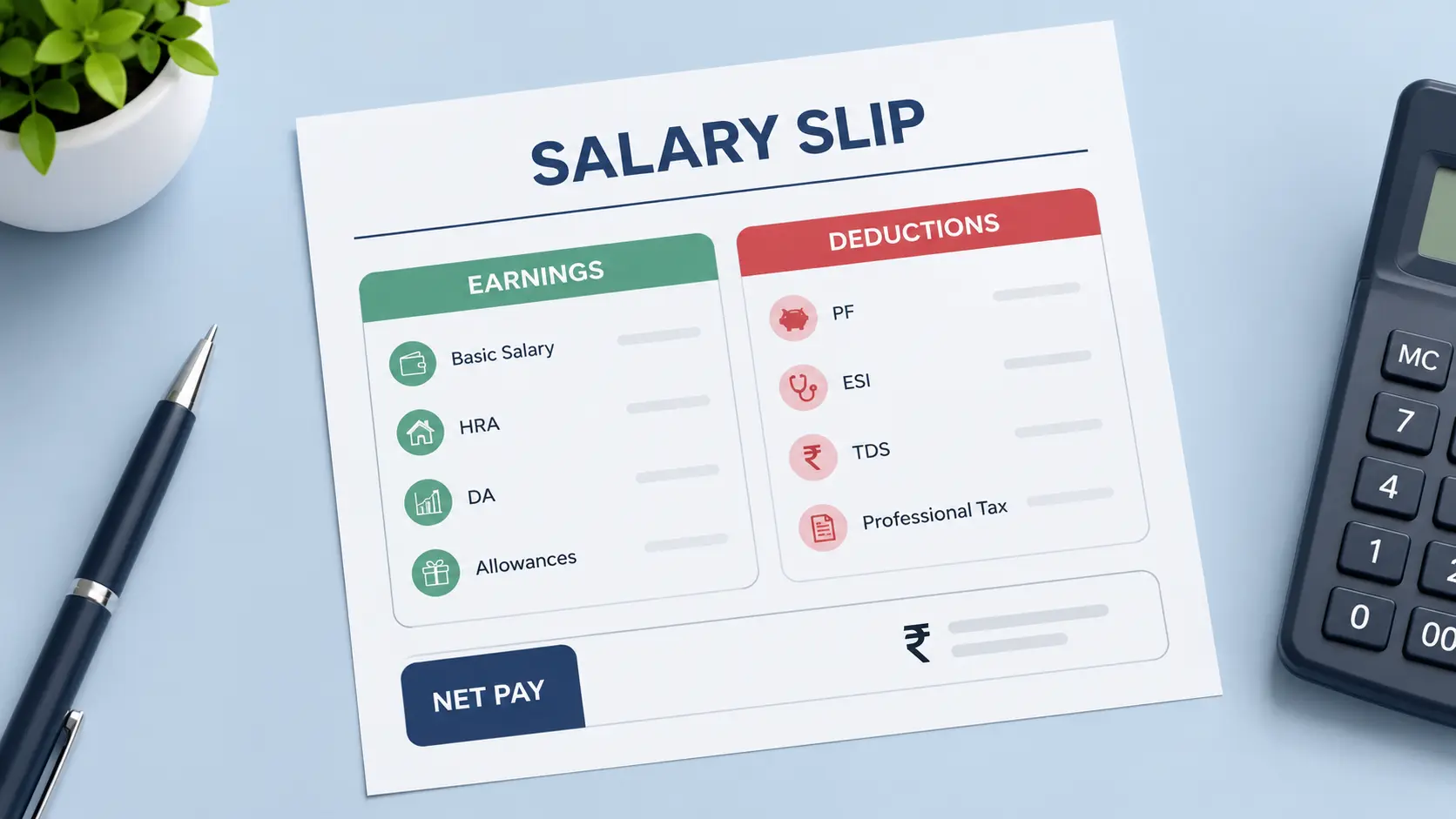
A salary slip (or payslip) is a monthly document from an employer that breaks down an employee's earnings and deductions — typically split into Basic Salary, HRA, DA, and allowances on the earnings side, and PF, ESI, TDS, and professional tax on the deductions side, with the difference being the net take-home pay. Most Indian salary slips follow a similar structure, even though the exact components vary by company.
Standard Salary Slip Format
| Earnings | Amount | Deductions | Amount |
|---|---|---|---|
| Basic Salary | ₹30,000 | Provident Fund (PF) | ₹3,600 |
| House Rent Allowance (HRA) | ₹12,000 | Professional Tax (PT) | ₹200 |
| Dearness Allowance (DA) | ₹2,000 | TDS | ₹1,500 |
| Conveyance Allowance | ₹1,600 | ESI (if applicable) | ₹300 |
| Special Allowance | ₹5,000 | ||
| Gross Salary | ₹50,600 | Total Deductions | ₹5,600 |
| Net Salary (Take-Home) | ₹45,000 |
Earnings Components Explained
Basic Salary
The fixed core of your pay, usually 40–50% of gross salary. Most other components (HRA, PF, gratuity) are calculated as a percentage of Basic.
House Rent Allowance (HRA)
Paid to help cover rent. Partially or fully tax-exempt depending on actual rent paid, city of residence, and salary — governed by Section 10(13A) of the Income Tax Act.
Dearness Allowance (DA)
A cost-of-living adjustment, more common in government and PSU jobs, though some private companies include it too.
Conveyance / Transport Allowance
Covers commute costs. Often a fixed monthly amount.
Special Allowance
A flexible catch-all component companies use to balance the total CTC after fixing Basic, HRA, and other heads.
Bonus / Incentives (if applicable)
Performance-linked or festival bonuses, shown separately when paid in that cycle.
Deduction Components Explained
Provident Fund (PF)
12% of Basic + DA, deducted for retirement savings, matched by the employer (see our detailed PF guide for the full breakdown).
Professional Tax (PT)
A small state-level tax, amount varies by state (some states don't levy it at all).
TDS (Tax Deducted at Source)
Income tax deducted monthly based on your estimated annual tax liability, adjusted against declared investments and exemptions.
ESI (Employee State Insurance)
Applicable if gross salary is below a government-set threshold; funds medical and disability benefits.
Loan/Advance Recovery (if applicable)
Any company loan or salary advance being recovered in installments.
Gross Salary vs Net Salary
- Gross Salary = Basic + HRA + DA + all allowances (before any deductions)
- Net Salary (Take-Home) = Gross Salary − (PF + PT + TDS + ESI + other deductions)
This is the single most common point of confusion for new employees comparing an offer letter's CTC to their actual monthly credit.
Why Salary Slip Components Vary by Company
There's no single legally mandated format. The Payment of Wages Act and Code on Wages set rules around what counts as "wages" for compliance purposes, but the exact line items, allowance names, and layout are decided by each employer — which is why two companies' payslips for the same gross salary can look quite different.
Want to create one yourself? Our free payslip generator builds a compliant payslip from these same components in minutes.
Manually preparing payslips every month leads to errors and compliance headaches. Reach out to our team at info@meagle360.com or WhatsApp us, or book a 15-minute demo to see automatic, compliant salary slips in action.