CTC to In-Hand Salary Calculator
Convert your CTC to in-hand salary instantly with this free calculator.
Get a full breakdown of your actual monthly take-home.
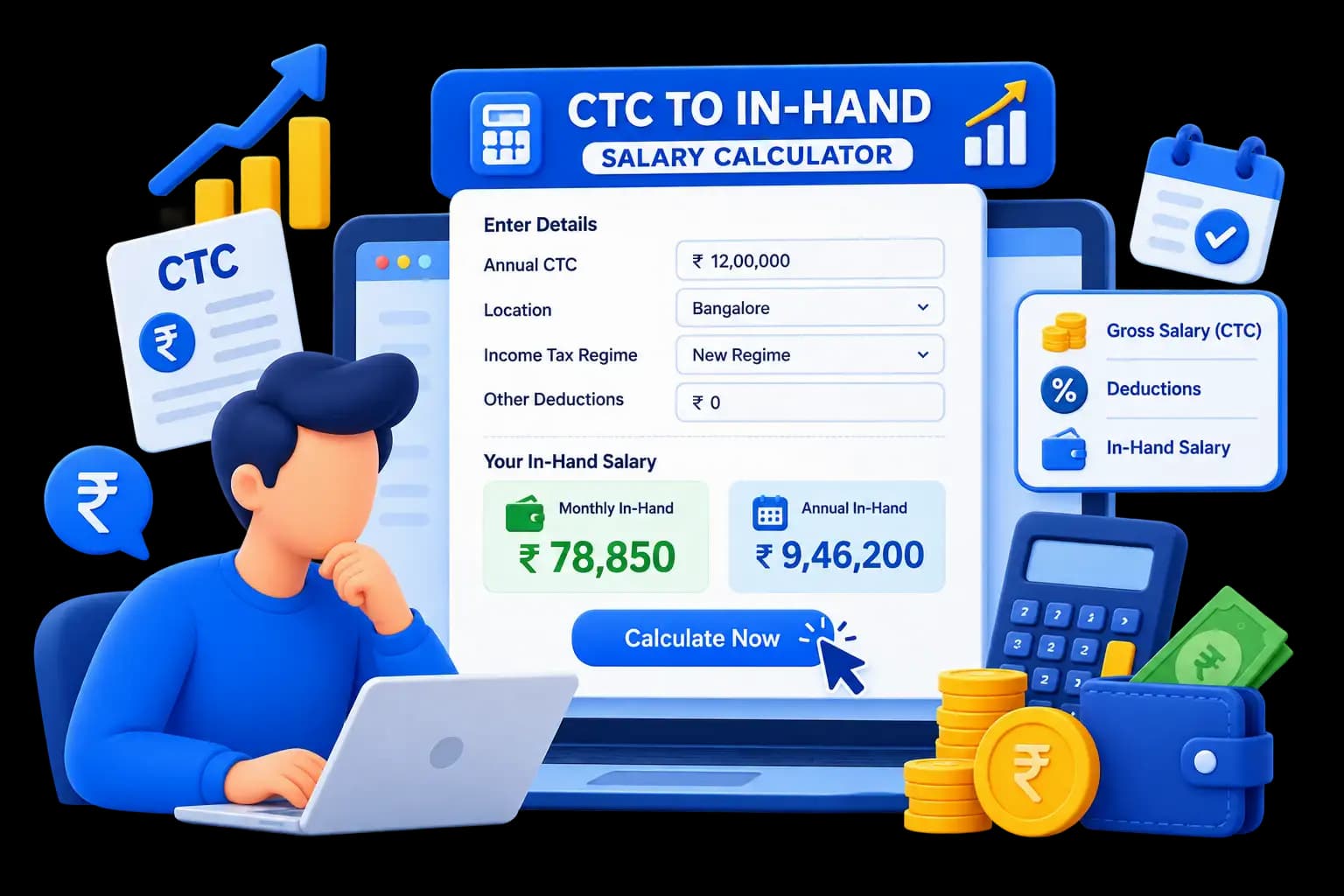
Convert your CTC to in-hand salary instantly with this free calculator.
Get a full breakdown of your actual monthly take-home.
The total cost-to-company figure from your offer letter
Basic, HRA, Special Allowance, employer PF, and gratuity, using standard structuring ratios
Employee PF (12% of Basic), Professional Tax, and estimated TDS
Both monthly and annual, alongside the full breakup
Three components inflate CTC without ever touching your monthly bank credit.
Goes into your retirement account, not your salary account — it never shows up in your monthly credit.
Accrues annually but is only paid out when you leave after 5+ years of service.
Added to CTC as value, never paid out as cash in your monthly salary.
This is why a ₹9,00,000 CTC often results in roughly ₹54,000/month in-hand, not ₹75,000 (₹9L ÷ 12) as many people initially assume. For the full formula and a worked example, see our CTC vs In-Hand Salary guide.
Compare two job offers on actual take-home pay, not just the headline CTC number, before deciding.
Explain CTC breakups to candidates instantly during offer discussions, instead of building a spreadsheet each time.
Understand the real monthly cash outflow of a hire, and reverse-calculate the CTC needed to hit a target in-hand figure.
Subtract employer contributions (PF, gratuity, insurance) from your CTC to get gross salary, divide by 12 for the monthly figure, then subtract employee deductions like PF, professional tax, and TDS to get your in-hand salary.
Because CTC includes components like employer PF contribution, gratuity, and insurance that are never paid out as monthly cash — only your actual gross salary minus deductions reaches your bank account.
It provides a close estimate based on standard salary structuring practices, and it's completely free to use. Exact figures can vary slightly since companies structure CTC components (Basic %, HRA %, allowances) differently.
Yes, HR teams can use it to quickly show candidates what a given CTC translates to in monthly take-home, speeding up offer discussions.
It estimates TDS using the New Tax Regime slabs, which is the default regime since FY 2023-24. For an exact comparison against the Old Regime, see our dedicated income tax guide.
For a ₹15,000 monthly CTC (₹1,80,000 annual), using this calculator's standard assumptions (40% Basic, 12% PF), the in-hand salary works out to approximately ₹13,000-13,300 per month after employee PF and other standard deductions. Professional Tax may not apply at this income level depending on your state, and no income tax is due.
For an ₹18,000 monthly CTC (₹2,16,000 annual), with the same standard structure, the in-hand salary works out to approximately ₹15,700-15,950 per month. Professional Tax applicability varies by state at this income level, and no income tax is due.
For a ₹20,000 monthly CTC (₹2,40,000 annual), the in-hand salary works out to approximately ₹17,450-17,700 per month, after employee PF and Professional Tax (where applicable, typically around ₹200/month in states that levy it). No income tax is due.
For a ₹30,000 monthly CTC (₹3,60,000 annual), the in-hand salary works out to approximately ₹26,300-26,550 per month, after employee PF and Professional Tax (where applicable). No income tax is due at this level under the New Regime.
For a ₹14,00,000 annual CTC, assuming a standard structure (40% Basic, 12% PF, New Tax Regime), the monthly in-hand salary works out to approximately ₹97,400-97,650 after employer PF, gratuity provisioning, employee PF, income tax, and Professional Tax. Exact take-home depends on your specific salary structure and any additional deductions — enter this CTC above to see your own breakdown.
Subtract employer contributions (PF, gratuity, insurance) from CTC to get gross salary, then subtract employee-side deductions like employee PF, Professional Tax, and TDS from gross salary to arrive at in-hand salary. Use the calculator above to get this instantly for any CTC amount.
Working backward from a target in-hand salary to CTC means adding back employee deductions to get gross salary, then adding employer-side contributions (employer PF, gratuity provisioning) to arrive at CTC. This is less precise than the forward calculation since it depends on assumptions about salary structure, and exact figures vary by company.
Meagle 360 generates instant, automatic CTC-to-in-hand breakdowns for every employee on your team.
Book a free demo