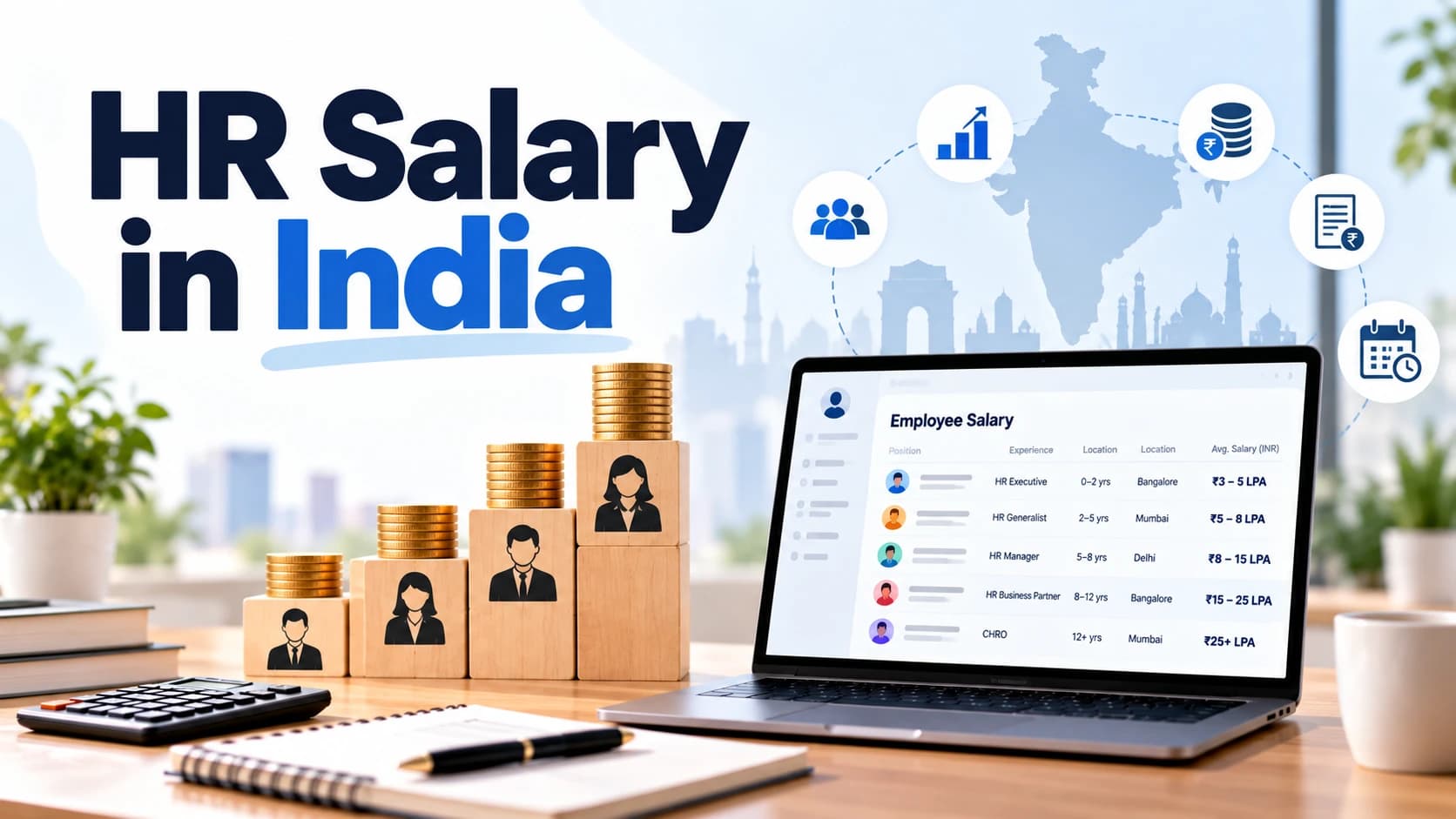
HR salaries in India range widely by role and experience, from roughly ₹2-3.5 lakh per annum for a fresher HR executive to ₹15 lakh or more annually for a senior HR manager, with the biggest jump coming when a professional moves from operational HR work into strategic, business-facing roles. There's no single "HR salary" because the function itself spans very different levels of responsibility, from onboarding coordination to compensation strategy.
HR Salary by Role (Compiled from Current Market Data)
| Role | Average Annual Salary | Typical Range |
|---|---|---|
| HR Executive | ₹3.3 lakh | ₹2 - 5.5 lakh |
| HR Generalist | ₹5.5 lakh | ₹3.8 - 8 lakh |
| HR Manager | ₹10.6 lakh | ₹6 - 15.3 lakh |
| HR (all roles, blended average) | ₹6.1 lakh | ₹3.8 - 11.6 lakh |
Figures compiled from Glassdoor's India salary data (based on thousands of self-reported salaries), current as of 2026. Actual pay varies significantly by city, company size, and industry.
HR Salary by Experience Level
Freshers (0-2 years)
- Non-MBA HR Executive at a small/mid-size firm: ₹2 - 3.5 lakh/year
- MBA HR fresher from a mid-tier college: ₹3.5 - 5.5 lakh/year
- MBA HR fresher from a premier B-school (XLRI, TISS, SCMHRD, etc.): ₹8 - 14 lakh/year
The gap between a non-MBA fresher and a premier-B-school MBA fresher is often 3-4x, reflecting how much India's HR job market weights formal credentials at entry level.
Mid-career (2-5 years)
Typically ₹5.5 - 6.5 lakh/year for an HR Executive or Generalist role, though this shifts significantly based on company size, city, and whether the role has started taking on specialized responsibility (compensation, talent acquisition, HRBP work) versus purely operational tasks.
Senior/leadership (8+ years, HR Manager and above)
₹10 - 15+ lakh/year is common, with HR leadership roles at larger companies or in high-paying industries (BFSI, IT/tech) frequently exceeding this range. See how a headline CTC figure like this actually breaks down into take-home pay in our CTC vs in-hand salary guide.
Why the Range Is So Wide
Unlike some functions where salary bands are fairly predictable by tenure, HR salaries vary more because the role itself varies more. An HR professional focused on documentation, onboarding, or coordination is compensated very differently from an HR Business Partner involved in workforce planning, compliance risk, or compensation decisions, even at similar years of experience. Responsibility and scope, not just designation or tenure, is what moves HR pay upward. And how much of any of these CTC figures actually reaches your bank account also depends on factors like the new labour codes' 50% wage rule, which affects PF and gratuity contributions across the board.
The Gender Pay Gap in HR
Industry salary data indicates a gender pay gap across Indian industries in the range of 19-31%, with the gap widest in manufacturing and construction and narrowest in IT and education. The gap tends to be more pronounced among older age groups and has been gradually narrowing among professionals in their 20s and early 30s. This pattern reflects broader Indian workforce trends and is not unique to HR roles specifically.
City-Wise Variation
HR salaries in India are not uniform across cities. Metro cities (Mumbai, Bengaluru, Delhi NCR) and IT/BFSI-heavy hubs typically pay meaningfully above the national average for equivalent HR roles, while smaller cities and tier-2/3 locations tend to sit below it, reflecting general cost-of-living and industry-concentration differences rather than anything HR-specific.
How HR Teams Can Use This Data
For HR professionals benchmarking their own pay, or HR leaders setting compensation bands for their team, a simple 5-step approach works well:
- Define a comparison set of similar companies (size, industry, city)
- Collect market data from multiple sources (Glassdoor, AmbitionBox, LinkedIn Salary Insights) rather than relying on one
- Map your own team's current compensation by role, experience, and location
- Establish pay bands with clear minimums and maximums per role
- Review annually alongside increment cycles, since these figures shift year to year
Once pay bands are set, seeing exactly how a number translates onto an employee's actual payslip is where a lot of compensation confusion happens — our salary slip format guide breaks down what every component means.
Benchmarking and managing compensation across your HR team gets complicated fast without the right system. Meagle 360 keeps salary structures, payroll, and reporting organized in one place. Book a free demo →