India's four new Labour Codes came into force on November 21, 2025, consolidating 29 older central labour laws into a single framework, with the most consequential change being a new wage definition that requires Basic Pay plus Dearness Allowance to make up at least 50% of an employee's total CTC. For employers, this means most existing salary structures now need to be reviewed and restructured, since keeping Basic Pay artificially low to reduce PF and gratuity costs is no longer compliant.
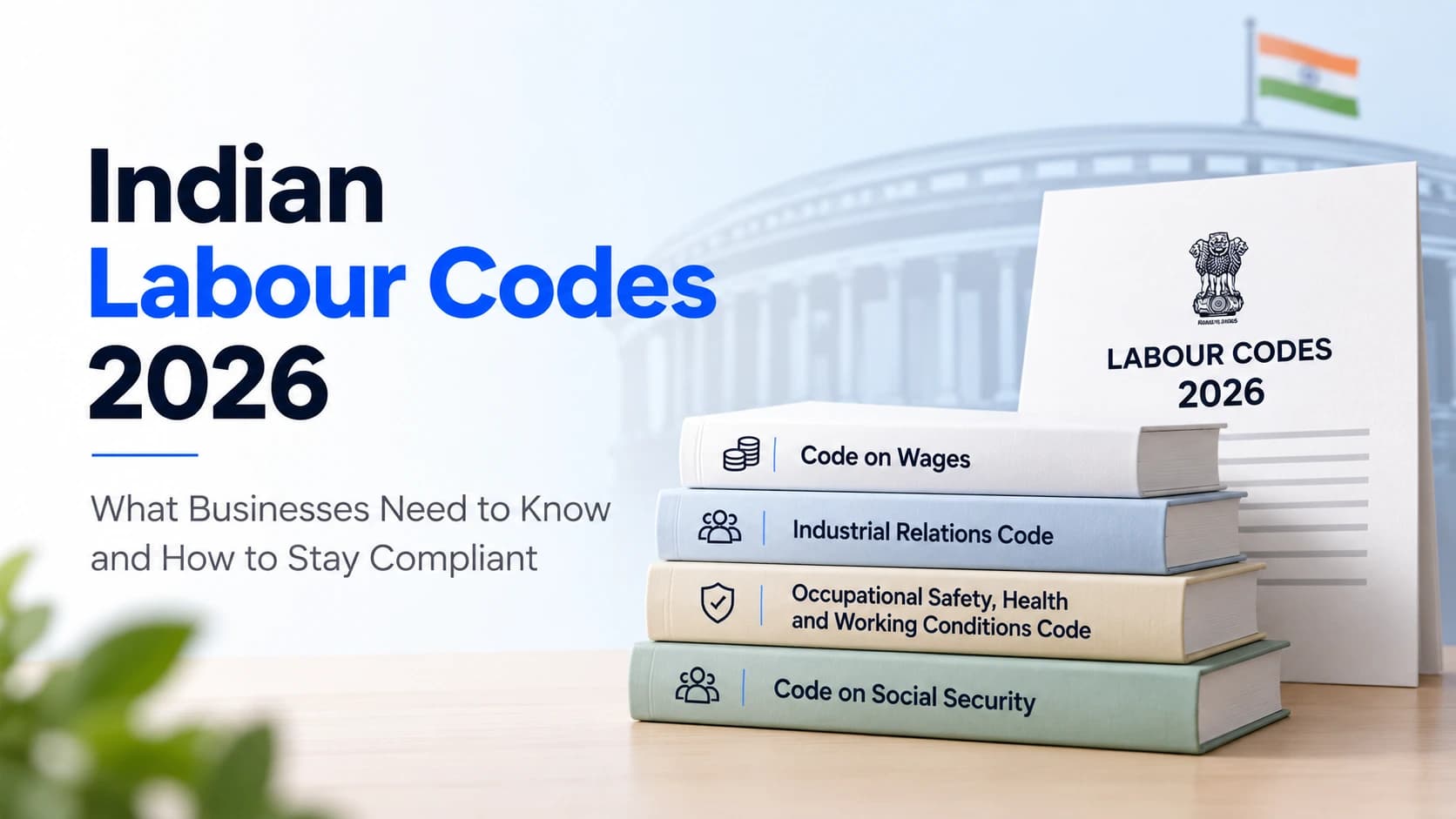
The Four Codes, at a Glance
| Code | What It Covers |
|---|---|
| Code on Wages, 2019 | Wage definition, minimum wages, bonus, payment of wages |
| Code on Social Security, 2020 | PF, ESI, gratuity, maternity benefit, gig/platform worker coverage |
| Industrial Relations Code, 2020 | Hiring, termination, dispute resolution, fixed-term employment |
| Occupational Safety, Health and Working Conditions Code, 2020 | Working hours, safety standards, women working night shifts |
All four were brought into force together by the Ministry of Labour & Employment on November 21, 2025. Detailed central and state-level implementing rules are still being notified through 2026, so some specifics continue to be finalized even though the codes themselves are legally in effect.
New Labour Code Salary Structure: The 50% Wage Rule
For years, most Indian companies structured CTC with Basic Pay deliberately kept low, often 25-40% of total compensation, while the rest was loaded into HRA, special allowances, and other components. This reduced the employer's PF and gratuity liability, since those are calculated as a percentage of Basic Pay, and it boosted the employee's monthly take-home.
The Code on Wages ends that practice. The rule:
Wages (Basic + DA + Retaining Allowance) must be ≥ 50% of total remunerationIf allowances and other excluded components push wages below 50% of CTC, the excess is automatically added back into "wages" for statutory calculation purposes, regardless of what the payslip labels it.
What This Actually Means for Take-Home Pay
Example: A company has an employee at ₹10,00,000 annual CTC with Basic Pay previously set at ₹3,00,000 (30%). Under the new rule, Basic Pay must rise to at least ₹5,00,000 (50%).
- PF contribution (12% of Basic) rises from ₹36,000/year to ₹60,000/year, an increase of ₹24,000
- This additional amount comes out of the flexible allowance components that previously formed part of take-home pay
- Total CTC stays the same, but monthly take-home pay decreases, while PF and gratuity balances grow faster
This is not the company or employee losing money. It's a shift from immediate cash to deferred, mandatory retirement savings — see how the pieces fit together in our CTC vs in-hand salary breakdown. Some employers are choosing to raise overall CTC to offset the take-home reduction, but that's a company-specific decision, not a legal requirement.
Other Major Changes Employers Need to Act On
Mandatory appointment letters for everyone
Every new hire, including contractors, fixed-term employees, and gig or platform workers, must receive a formal appointment letter detailing role, wages, benefits, and working hours, under the Industrial Relations Code and OSH Code.
Fixed-term employees get faster benefit eligibility
Fixed-term employees now qualify for gratuity after 1 year of service, down from the previous 5-year requirement for permanent employees. This is a significant shift in benefit eligibility timelines that payroll systems need to account for.
Overtime is now voluntary and paid at 2x wages
Employees cannot be compelled to work overtime, and where they do, it must be compensated at twice the normal wage rate.
Expanded coverage for gig and platform workers
The Code on Social Security extends social security coverage, including a framework for benefits, to gig and platform workers for the first time, a segment of the workforce that fell outside traditional labour law protections.
Free annual health checks for employees over 40
Employers are required to provide free annual health checkups for employees above age 40 under the OSH Code.
What Employers Should Do Now
- Audit current salary structures against the 50% wage rule, identify which employee categories fall short
- Recalculate PF and gratuity bases for affected employees and model the CTC/take-home impact before rolling out changes
- Issue compliant appointment letters to all hires, including contract and gig workers, if this isn't already standard practice
- Review fixed-term employee records for gratuity eligibility under the new 1-year threshold
- Track state-specific rule notifications, since implementing rules are still being finalized at the state level through 2026 and can affect compliance timelines regionally
- Communicate the take-home change clearly to employees before it appears on a payslip unexplained, since a lower monthly credit with the same CTC can otherwise look like an unexplained pay cut
Why This Isn't a One-Time Compliance Task
Because state-level rules are still being notified, this isn't a single restructuring exercise to complete and move on from. Payroll and HR teams should expect further clarifications and regional variations to roll in through 2026, making this an ongoing compliance area rather than a one-time fix.
For more on how the pieces connect: what PF actually is and how it's deducted, and how the Code on Social Security fits into India's broader leave policy landscape.
Restructuring salary components and recalculating PF and gratuity across your whole team manually is exactly where compliance risk creeps in. Meagle 360 keeps payroll calculations aligned with current statutory rules automatically. Book a free demo →