Last updated: October 24, 2026. This is a general guide, not legal advice. Rules and due dates can change, and some depend on your state. Confirm on the official portals (EPFO, ESIC, TRACES and your state labour department) before filing. Meagle 360 publishes this page.
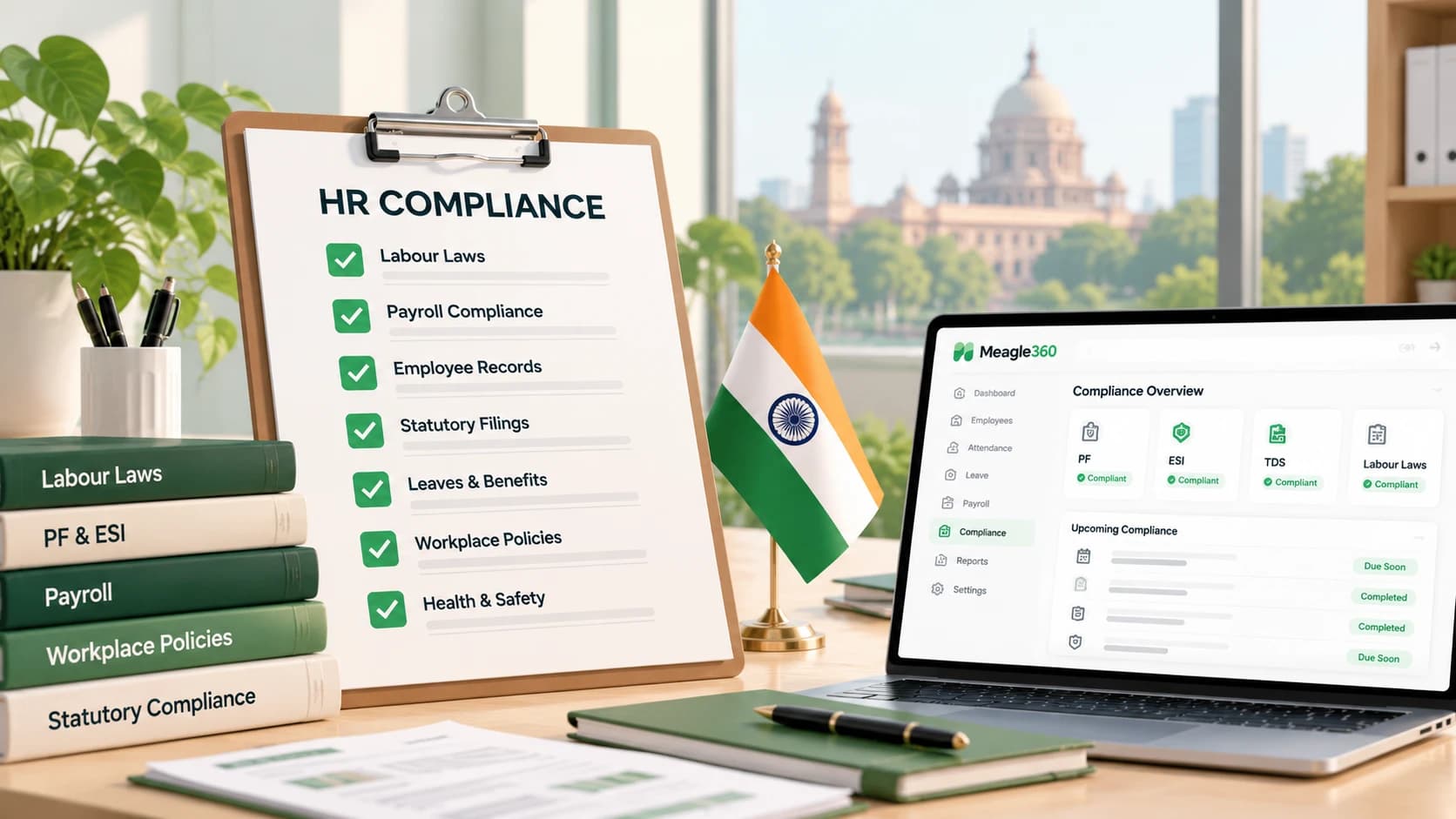
The core HR compliance deadlines for an Indian employer are: TDS on salary by the 7th, PF and ESI by the 15th of every month, quarterly TDS returns (Form 24Q) on 31 July, 31 October, 31 January and 31 May, and Form 16 to employees by 15 June. Professional tax and labour welfare fund dates depend on your state.
Below is the full checklist: what applies to you, what to do every month, every quarter and every year, and the mistakes that most often lead to penalties. Bookmark it.
Step 1: Which Rules Apply to Your Business?
Many obligations start only after you cross an employee count. Use this as a quick check (the thresholds below are the generally applicable ones, confirm for your state and industry):
| Obligation | When it generally applies |
|---|---|
| Provident Fund (EPF) | 20 or more employees |
| ESI (health insurance and benefits) | 10 or more employees, for employees earning up to ₹21,000 a month (in ESIC-notified areas) |
| Gratuity | 10 or more employees |
| Statutory bonus | 20 or more employees |
| Professional tax | State-wise. Depends on whether your state levies it |
| Labour welfare fund | State-wise. Some states have none |
| Shops and Establishments registration | State-wise, usually from the day you start operating |
| TDS on salary | When employees' taxable income crosses the exemption limit |
Not sure where you stand? A team of 10 employees may already need ESI and gratuity. At 20 employees, PF and bonus usually start too.
Step 2: Monthly HR Compliance Checklist
| By | What to do | Notes |
|---|---|---|
| 7th | Deposit TDS deducted from salaries of the previous month | For March salaries, the deadline is 30 April |
| 15th | Pay PF contribution and file the PF ECR for the previous month | Employer and employee share both |
| 15th | Pay ESI contribution for the previous month | For employees within the ESI wage limit |
| State date | Pay professional tax | Dates vary by state, commonly around the 10th, 15th, 20th or last day of the month |
| State date | Pay labour welfare fund, where applicable | Monthly in some states, half-yearly or yearly in others |
| Every month | Issue payslips to all employees | Itemised earnings and deductions |
| Every month | Finalise attendance, leave and overtime before running payroll | Errors here become payroll errors |
| Every month | Update records for joiners, leavers and changes in salary | Needed for PF, ESI and TDS |
Tip: the dates above are the legal limits, not safe targets. Aim to pay 2 to 3 days earlier, because portals are slow near the deadline.
Want these calculations done automatically? See how Meagle 360 payroll works
Step 3: Quarterly Checklist (TDS Returns)
| Quarter | Period | Form 24Q due date |
|---|---|---|
| Q1 | April to June | 31 July |
| Q2 | July to September | 31 October |
| Q3 | October to December | 31 January |
| Q4 | January to March | 31 May |
Also each quarter: reconcile the TDS you deducted with what you deposited, and check that every employee's PAN is correct in your records.
Step 4: Annual Checklist
| When | What | Notes |
|---|---|---|
| By 15 June | Issue Form 16 to employees for the previous financial year | Generated after Q4 return |
| Within 8 months of year end | Pay statutory bonus, if applicable | 30 November for an April to March year |
| State date | File labour welfare fund contribution and annual returns, where applicable | Check your state |
| State date | File Shops and Establishments annual return and renew registration | Check your state |
| Before 31 March | Collect investment proofs and finalise employees' tax declarations | Avoids last-month TDS surprises |
| Every year | Review leave policy, holiday list and appointment letter format | Link: leave policy template |
Step 5: One-Time and Event-Based Compliance
- When you cross a threshold: register for PF and ESI, and for gratuity and bonus if they now apply
- Every new joiner: issue an appointment letter (the new labour codes make appointment letters mandatory for all workers). Use our appointment letter template
- Every joiner: collect documents, bank details, UAN and ESI details, and PF nomination
- Every leaver: issue a relieving and experience letter, complete full and final settlement, update PF exit. See relieving and experience letter
- Gratuity: pay when an eligible employee leaves, within the time the law requires
- Disciplinary action: follow a written process, see warning letter and show-cause notice templates
What the New Labour Codes Changed for Employers
The four labour codes (Wages, Industrial Relations, Social Security, and Occupational Safety, Health and Working Conditions) came into force on 21 November 2025. In practice for a small employer:
- Appointment letters are mandatory for all workers
- Fixed-term employees get the same benefits as permanent staff and become eligible for gratuity after one year of service
- A single registration, licence and annual return is meant to replace several overlapping filings
- Social security coverage is extended to more categories of workers, including contract and gig workers
The government is still framing parts of the rules. Until those are finalised, provisions of the older laws continue to apply in the areas not yet covered, so check what applies to your business. For a deeper read, see our labour codes compliance guide.
Records to Keep (and Keep Organised)
- Attendance records and leave records
- Wage and salary records, payslips and deductions
- Employee documents: appointment letter, ID, bank and PF details
- PF, ESI, TDS and professional tax payment proofs and filings
- Appraisal, increment and disciplinary records
Keep them for the period your state and the applicable law require (this can be several years). A structured sheet helps: try our free employee database template.
7 Compliance Mistakes That Lead to Penalties
- Paying PF or ESI on the last day. Portal delays and bank cut-offs make you late. Late payment attracts interest and penalties.
- Wrong wage base. PF and ESI depend on what counts as wages. Using the wrong base leads to short payment.
- Missing professional tax or labour welfare fund because the due date differs by state.
- Not registering after crossing a threshold (20 employees for PF, 10 for ESI).
- Late or incorrect TDS returns from wrong PANs or mismatched deposits.
- No appointment letters or payslips for some employees.
- Manual spreadsheets for everything. One wrong formula flows into PF, ESI and TDS at the same time. See HRMS vs Excel: when to switch.
Month-End Routine: A Simple 8-Step Checklist
- Close attendance and leave for the month
- Add joiners, leavers and salary changes
- Run payroll and check totals
- Pay PF, ESI and professional tax well before the due date
- Deposit TDS by the 7th of next month
- Issue payslips
- Save payment proofs and filings in one folder
- Note next month's dates, including any state-specific ones
When Software Makes Sense
Tracking dates is easy. Getting the numbers right every month, for every employee, is the hard part. An HRMS with payroll calculates PF, ESI and TDS from attendance, generates payslips and keeps records in one place. See Meagle 360 payroll software and our guide on payroll software pricing in India.
Tired of checking dates and recalculating PF, ESI and TDS by hand every month? Meagle 360 runs payroll from your attendance data with PF, ESI and TDS built in. Book a free demo
Sources
- Employer compliance due dates (monthly, quarterly, annual): Onsurity HR compliance calendar guide
- Payroll due dates by state (PT, LWF): Paybooks payroll compliance calendar
- Labour codes in force from 21 November 2025: KPMG Flash News
- Confirm all dates on the official portals: EPFO (epfindia.gov.in), ESIC (esic.gov.in), TRACES (tdscpc.gov.in) and your state labour department