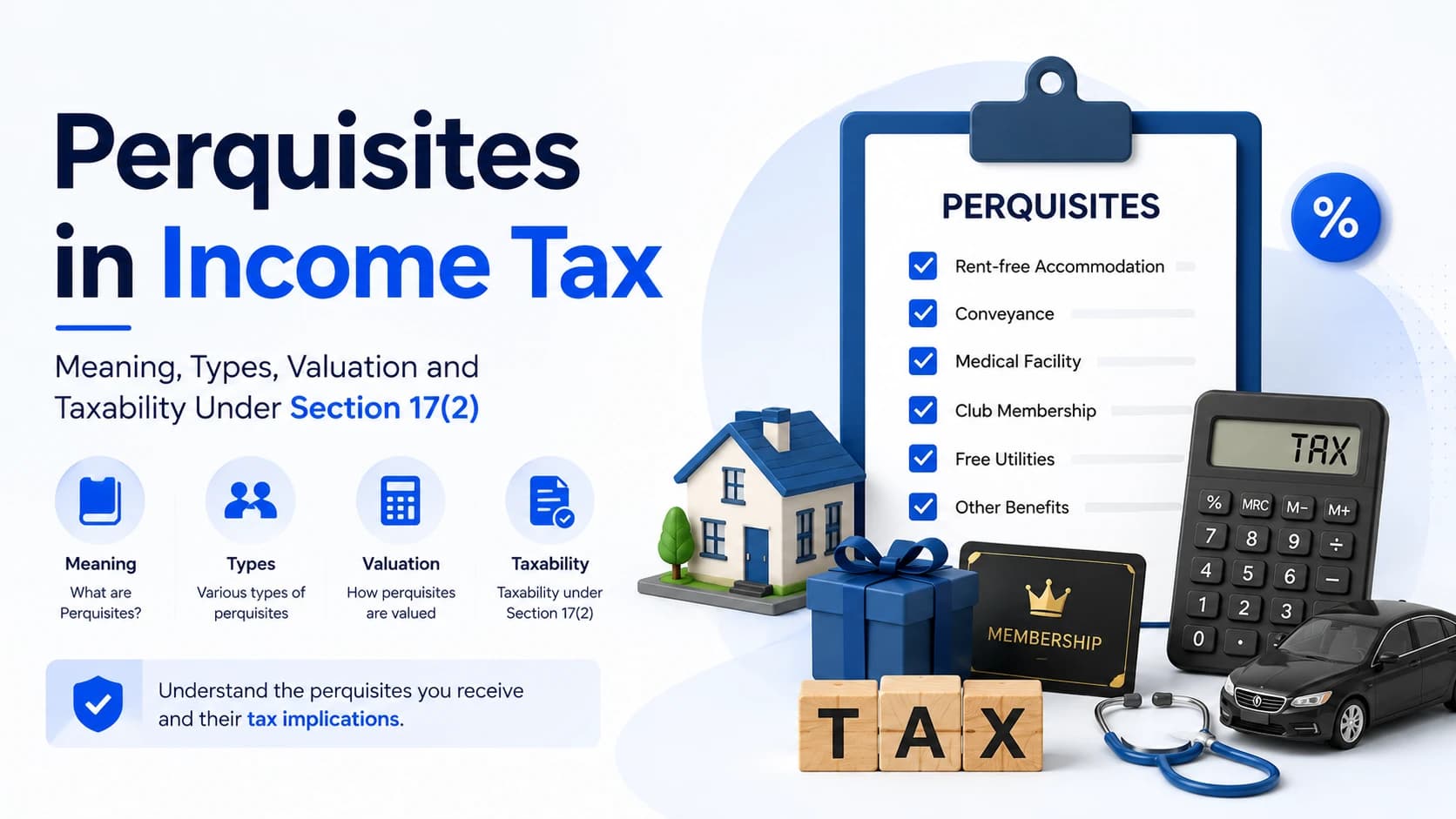
A perquisite is any non-cash benefit, facility, or advantage an employer provides to an employee beyond regular salary — such as rent-free accommodation, a company car, interest-free loans, or employer contributions to PF/NPS above a threshold — and it is taxed as part of "Salary" income under Section 17(2) of the Income Tax Act, valued according to Rule 3 (now Rule 15 of the Income-tax Rules, 2026). Imagine an employee provided a company flat and a car: neither pays them cash directly, yet both count as taxable income.
What Counts as a Perquisite
Under Section 17(2), perquisites include:
- Rent-free or concessional accommodation provided by the employer
- Company car or vehicle provided for personal/mixed use
- Interest-free or concessional loans
- Sweat equity shares allotted at a concessional rate or free of cost
- Employer contributions to PF, NPS, or superannuation fund exceeding ₹7,50,000 combined annually
- Any obligation of the employee that the employer pays on their behalf
- Free or concessional medical facilities, credit cards, club memberships, and similar benefits
The Three Categories of Perquisites
- Fully taxable perquisites — e.g., rent-free accommodation, employer-paid club memberships
- Tax-exempt perquisites — e.g., small loans below the threshold, medical treatment for specified diseases
- Partially taxable perquisites — e.g., employer PF/NPS contributions, taxable only above ₹7,50,000
How Common Perquisites Are Valued
Rent-Free Accommodation
For non-government employees, valued as a percentage of salary based on city population:
| City Population | Perquisite Value |
|---|---|
| Above 25 lakh | 15% of salary |
| 10–25 lakh | 10% of salary |
| Below 10 lakh | 7.5% of salary |
For government employees, valuation is based on the license fee determined by the government. Furnished accommodation adds a further 10% of furniture cost to this value.
Company Car
Valuation depends on whether it's used for official duty only (nil value, with logbook and certificate), mixed use (flat monthly value — see our detailed Fuel Reimbursement guide), or personal use only (actual cost basis).
Interest-Free or Concessional Loans
The taxable perquisite is the difference between the SBI lending rate for a similar loan (as of April 1 of the financial year) and what the employee is actually charged.
- Loans up to ₹20,000 are exempt from this valuation — this threshold is set to rise to ₹2,00,000 from April 1, 2026, per recent updates, though it's worth confirming against the latest notification before relying on it for a specific filing year
- Loans for treatment of diseases listed under Rule 3A are exempt entirely, unless later reimbursed by insurance
Employer PF/NPS/Superannuation Contributions
Exempt up to ₹7,50,000 combined per year across all three; any excess becomes a taxable perquisite, along with the interest/dividend accrued on that excess.
Meal Vouchers/Food Cards
From April 1, 2026, the tax-free limit for employer-provided meals rose to ₹200 per meal (up from ₹50 earlier), and this benefit is now available under the New Tax Regime as well, not just the Old Regime.
ESOPs (Employee Stock Option Plans)
The taxable perquisite is computed at the exercise date's fair market value, not the grant date — a common payroll error worth double-checking.
The Income Tax Act, 2025 — What Changes for Perquisites
The Income-tax Act, 2025 re-codifies these provisions, with Rule 15 of the Income-tax Rules, 2026 (effective April 1, 2026) replacing the earlier Rule 3. The core valuation mechanics — accommodation slabs, car slabs, SBI-rate loan benchmarking — continue substantively unchanged. For AY 2026-27 returns covering FY 2025-26 income, the existing Section 17(2)/Rule 3 references still apply; the new Act's numbering takes effect from Tax Year 2026-27 onward.
See also: our Fuel Reimbursement guide, Salary Slip Format guide, and PF in salary breakdown for related payroll components.
Getting perquisite valuation wrong on Form 12BA or Form 16 leads to compliance issues down the line. Reach out to our team at info@meagle360.com or WhatsApp us, or book a 15-minute demo to see correct perquisite valuation applied automatically across your payroll.