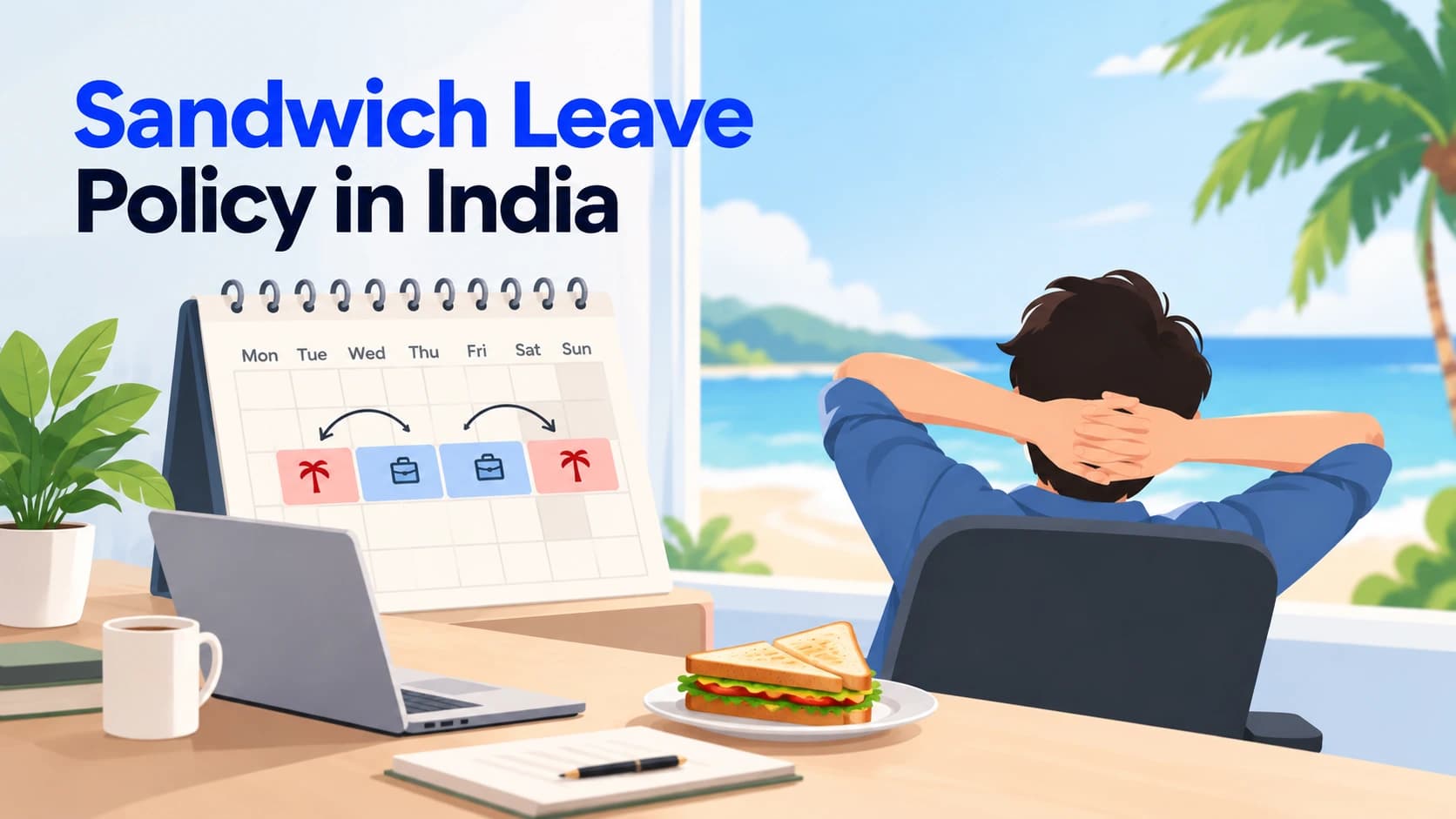
A sandwich leave policy is a company rule where, if an employee takes leave on the days immediately before and after a weekend or public holiday, the non-working days in between are also counted as leave, resulting in a larger deduction from their leave balance than the days actually applied for. There's no dedicated law in India that defines, mandates, or bans this practice, it's set entirely by individual company policy. For the broader picture of leave entitlements in India, see our leave policy in India guide.
How the Calculation Actually Works
Here's the pattern that catches most employees off guard:
Example: Wednesday is a public holiday. An employee takes leave on Thursday and returns on Monday.
| Day | Status | Without Sandwich Rule | With Sandwich Rule |
|---|---|---|---|
| Wednesday | Public holiday | Not counted as leave | Not counted as leave |
| Thursday | Leave applied | 1 day deducted | 1 day deducted |
| Friday | Working day | Not applicable | 1 day deducted (sandwiched) |
| Sat-Sun | Weekend | Not counted | Counted if company includes weekends |
| Monday | Back to work | — | — |
Depending on how the policy is written, an employee who intended to take one day off can end up with 2-4 days deducted from their leave balance, since the holiday and/or weekend sitting between two leave days gets absorbed into the leave block.
Is Sandwich Leave Policy Legal in India?
Yes, it's generally legal. There's no central Indian labour law that specifically defines, permits, or bans a sandwich leave policy. Companies are free to design their own leave-counting rules, provided two conditions are met:
- The policy is clearly documented in the employment contract or company leave policy, not applied informally or after the fact
- It doesn't reduce leave below the statutory minimum entitlements guaranteed under the applicable state's Shops and Establishments Act
For example, in Delhi, a sandwich leave rule cannot be used to cut into the earned, casual, or sick leave quotas the Delhi Shops and Establishments Act guarantees, the rule can only affect how bracketed leave around holidays is counted, not reduce the baseline entitlement itself. Statutory minimum leave entitlements are also part of the broader framework under India's new labour codes.
Why Companies Use This Policy
- Discourages employees from strategically taking one day of leave to convert a holiday into a long weekend
- Helps maintain predictable staffing levels around public holidays
- Common in manufacturing and production environments historically, where output was directly tied to consistent daily attendance, though it has since spread to many other industries
The Downside Employers Should Know
Sandwich leave policies are also a common source of employee frustration and distrust, especially when the rule isn't clearly communicated upfront. An employee who applies for one day of leave and later sees three or four days deducted, without having understood the rule in advance, is likely to feel misled, even if the policy is technically compliant. Clear, upfront documentation isn't just a legal safeguard, it's what keeps the policy from becoming a trust issue.
What Employees Should Check Before Applying
- Whether the company's leave policy document explicitly mentions a sandwich rule
- Whether weekends, public holidays, or both are included in the sandwich calculation
- Whether the rule applies to all leave types (casual, earned, sick) or only specific ones
- Whether the rule differs by location, since some companies apply different rules across offices in different states
What HR Teams Should Do
- Document the sandwich rule explicitly in the leave policy, not as an unwritten practice
- Communicate it clearly during onboarding, not only when an employee is surprised by a deduction
- Configure leave management software to apply the rule automatically and consistently, rather than relying on manual calculation, which is where most disputes originate
- Check that statutory minimum leave entitlements are never reduced by the rule, especially across offices in different states
Manually tracking which leave requests trigger a sandwich deduction is exactly where leave-policy disputes start. Meagle 360 applies your leave rules automatically and consistently, every time. Book a free demo →