Leave policy in India changed in a real way in 2026 — the Occupational Safety, Health and Working Conditions (OSH) Code became fully operational in April 2026 and standardised how earned leave accrues. Here's what a compliant, complete leave policy actually needs to cover.
Types of leave in India
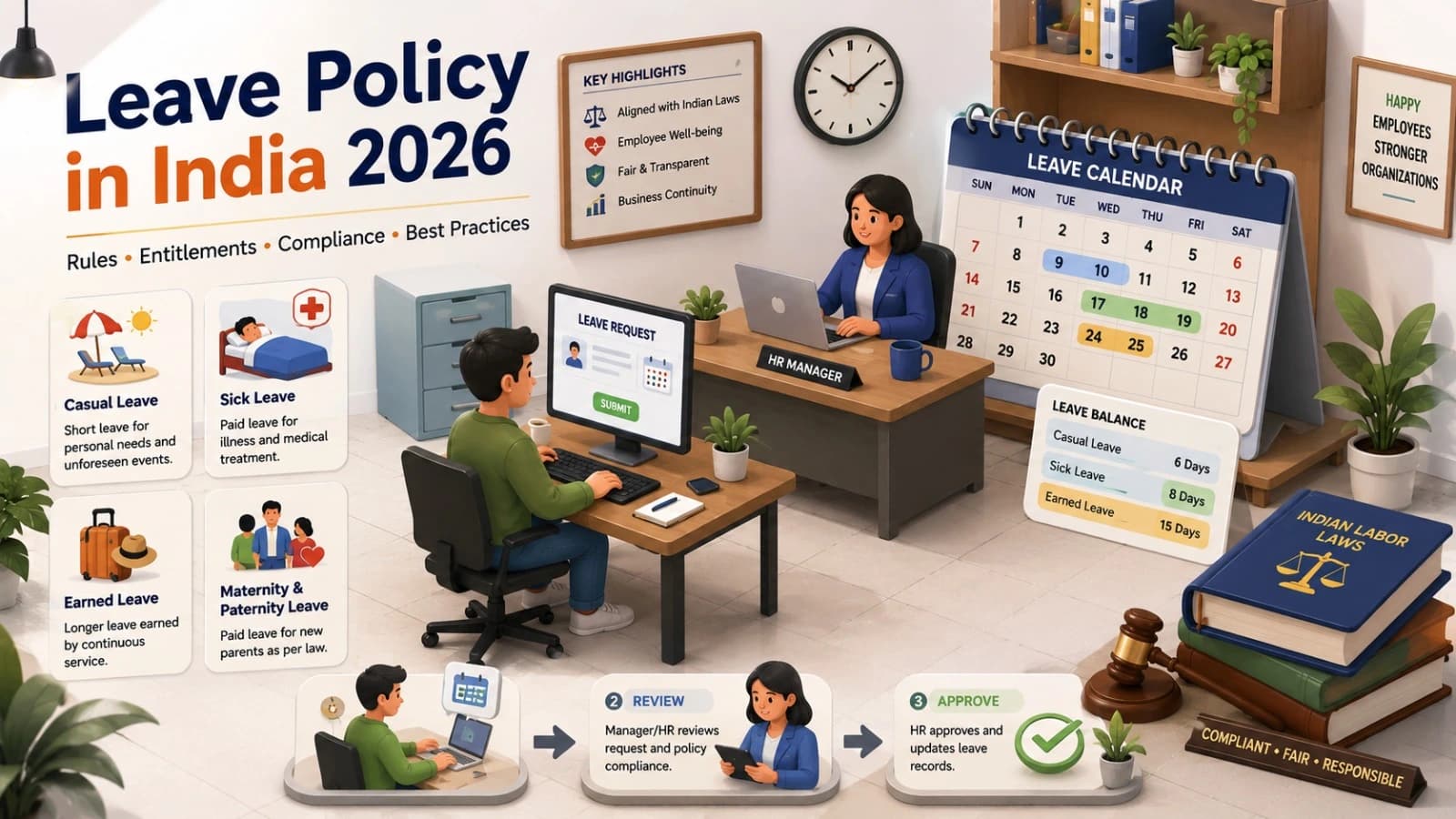
- Casual Leave (CL) — short, unplanned absences, typically 7–12 days/year depending on the state's Shops & Establishment Act
- Sick Leave (SL) — for illness, typically 7–12 days/year, generally not encashable
- Earned / Privileged Leave (EL/PL) — accrued leave that can usually be carried forward or encashed
- Maternity Leave — statutory, covered below
- Paternity Leave — not centrally mandated for private-sector employees (see below)
- Bereavement Leave — not statutory in most states, offered at the employer's discretion
- Public / National Holidays — set by each state, typically 10–14 days/year
- Compensatory Off (Comp-Off) — time off in lieu of working a holiday or weekend
Statutory leave entitlements in India
Leave entitlement in India isn't governed by one single national law — it comes from a mix of the Factories Act, 1948, state-specific Shops & Establishment Acts, and, since April 2026, the Occupational Safety, Health and Working Conditions (OSH) Code, 2020. Exact day counts still vary by state and establishment type, so always confirm the specific rule for your state via the Ministry of Labour and Employment.
What changed under the OSH Code in 2026
Two changes matter for every employer running payroll in India today:
- Earned leave accrual is now standardised at one day of earned leave for every 20 days worked, applied uniformly across establishments covered by the OSH Code — replacing the patchwork of state-specific accrual formulas that existed before.
- The eligibility threshold dropped from 240 days of work in a year to 180 days, meaning employees qualify for annual leave sooner. Contract and fixed-term employees are now also entitled to the same leave benefits as permanent employees under the same threshold.
Earned leave: how it accrues and how to calculate it
Under the standardised 1-day-per-20-days rule, an employee who works 240 days in a year accrues 12 days of earned leave (240 ÷ 20 = 12). Someone working closer to a full year — say 300 working days — accrues 15 days (300 ÷ 20 = 15). This replaces having to look up a different formula for every state.
Maternity leave rules in 2026
Under the Maternity Benefit Act, 1961 (as amended in 2017):
- 26 weeks of paid maternity leave for the first two children (up to 8 weeks of which can be taken before the expected delivery date)
- 12 weeks for the third child onward
This applies to establishments covered under the Act (generally those with 10 or more employees). Source: Maternity Benefit Act, 1961, as amended, via the Ministry of Labour and Employment.
Paternity leave, by contrast, is not currently mandated by central statute for private-sector employees — only central government employees have a statutory entitlement (15 days). Many private companies offer 5–15 days voluntarily as a policy choice, not a legal requirement.
The sandwich leave rule explained
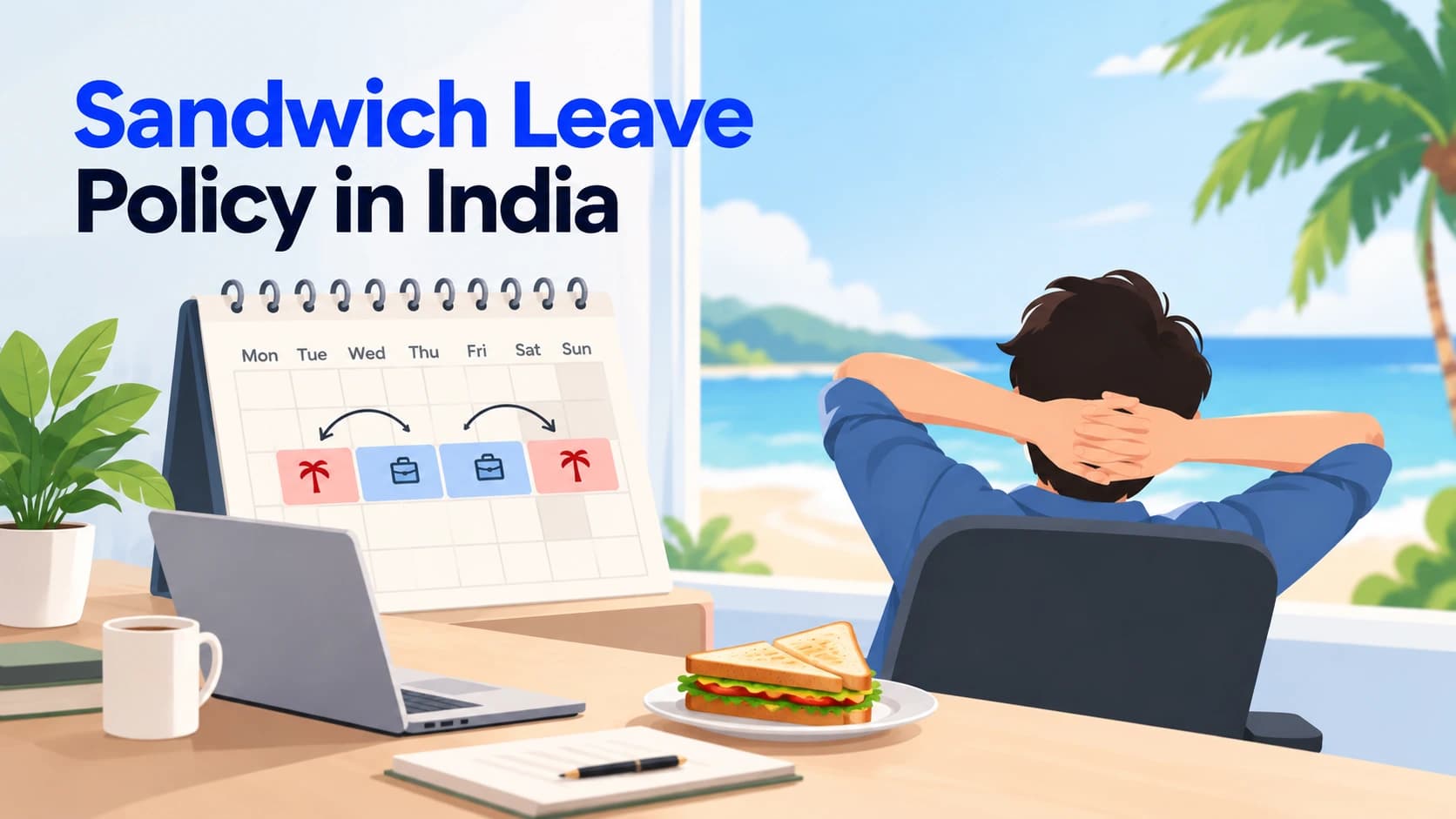
The "sandwich rule" treats a weekend or holiday falling between two days of approved leave as leave itself, rather than as a non-working day the employee gets "for free." For example, if an employee takes leave on Friday and the following Monday, the intervening Saturday and Sunday are counted as leave days too, not excluded from the leave balance. Whether a company applies this rule (and how strictly) is a policy choice, not a single uniform national law — it should be stated explicitly in the written policy so there's no dispute when it comes up. For the full calculation logic and worked examples, see our dedicated guide to the sandwich leave policy in India.
Leave encashment: when and how it works
Earned/privileged leave that isn't used is often encashable — either during employment (subject to a cap the company sets) or at the time of resignation, termination or retirement, when unused earned leave is typically paid out based on the employee's most recent basic salary. Casual and sick leave are generally not encashable. The specific encashment cap, timing and formula should be written into the company's leave policy rather than left to interpretation at exit time.
What a written leave policy should include
- Each leave type offered, with the exact number of days and any state-specific variation
- The accrual method and eligibility threshold (now standardised at 1 day per 20 days worked, 180-day eligibility, under the OSH Code)
- Carry-forward rules — how many unused days roll into the next year, if any
- Encashment rules — what's encashable, when, and at what rate
- Whether the sandwich leave rule applies, and how
- The approval process and who requests route to
Tracking all of this by hand across email and spreadsheets is exactly where leave balances start drifting out of date. Meagle 360's leave management module applies your configured policy — accrual rate, carry-forward, encashment caps — automatically, so the balance an employee sees is always the current one.
Tracking leave policy by hand across spreadsheets and email? Get in touch at info@meagle360.com or +91 80773 13241, or book a 15-minute demo to see it automated.