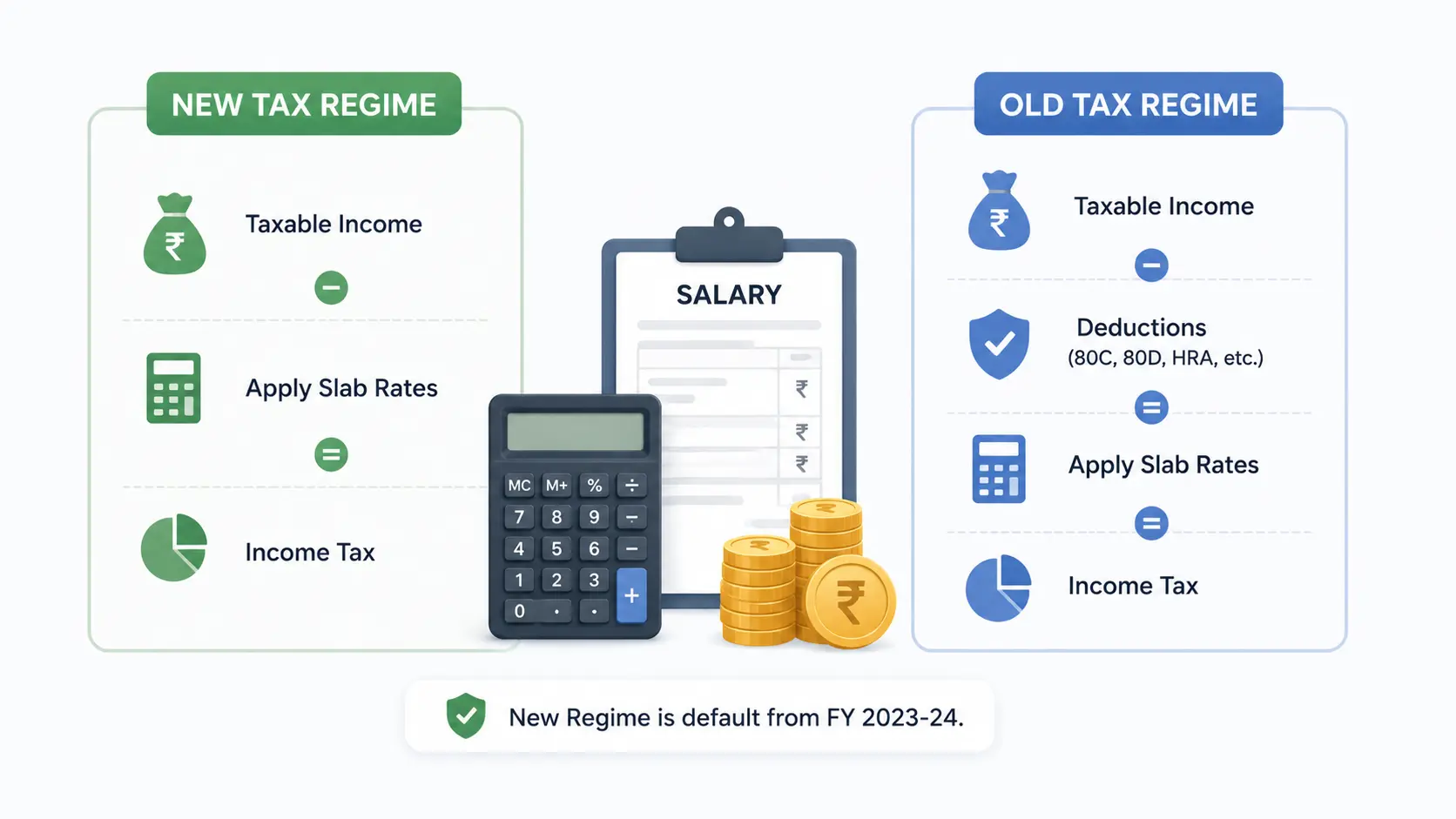
Income tax on salary in India is calculated by first arriving at taxable income (gross salary minus standard deduction and, under the old regime, other deductions), then applying slab rates based on either the New Tax Regime or the Old Tax Regime — with the New Regime being the default option since FY 2023-24. Under the New Regime, income up to ₹12.75 lakh (including the ₹75,000 standard deduction) is effectively tax-free due to the Section 87A rebate.
New Tax Regime Slabs (FY 2025-26, unchanged for FY 2026-27)
| Income SlabTax Rate | |
| Up to ₹4,00,000 | Nil |
| ₹4,00,001 – ₹8,00,000 | 5% |
| ₹8,00,001 – ₹12,00,000 | 10% |
| ₹12,00,001 – ₹16,00,000 | 15% |
| ₹16,00,001 – ₹20,00,000 | 20% |
| ₹20,00,001 – ₹24,00,000 | 25% |
| Above ₹24,00,000 | 30% |
- Standard deduction: ₹75,000
- Section 87A rebate: brings tax to zero for taxable income up to ₹12,00,000 (so gross salary up to ₹12,75,000 effectively pays no tax)
- Limited deductions allowed — mainly standard deduction and employer's NPS contribution
Old Tax Regime Slabs
| Income SlabTax Rate | |
| Up to ₹2,50,000 | Nil |
| ₹2,50,001 – ₹5,00,000 | 5% |
| ₹5,00,001 – ₹10,00,000 | 20% |
| Above ₹10,00,000 | 30% |
- Standard deduction: ₹50,000
- Allows deductions under Section 80C (up to ₹1.5 lakh), 80D (health insurance), HRA exemption, home loan interest, and more
- Requires opting in — the New Regime is default unless you actively choose Old
Step-by-Step: How to Calculate Your Tax
- Start with Gross Salary (Basic + HRA + Allowances, before deductions)
- Subtract Standard Deduction (₹75,000 in New Regime, ₹50,000 in Old Regime)
- Subtract other deductions — only applicable in Old Regime (80C, 80D, HRA exemption, etc.)
- Apply slab rates to the resulting taxable income
- Apply Section 87A rebate if taxable income qualifies (up to ₹12L in New Regime, ₹5L in Old Regime)
- Add 4% Health & Education Cess on the final tax amount
Worked Example: ₹12.75 Lakh Gross Salary
Under New Regime:
- Gross Salary: ₹12,75,000
- Less Standard Deduction: ₹75,000
- Taxable Income: ₹12,00,000
- Tax before rebate: ₹60,000 (Nil up to 4L + 5% on next 4L = ₹20,000 + 10% on next 4L = ₹40,000)
- Section 87A rebate: −₹60,000
- Final Tax Payable: ₹0
Under Old Regime (assuming ₹1.5L in 80C + ₹25,000 in 80D):
- Gross Salary: ₹12,75,000
- Less Standard Deduction: ₹50,000
- Less 80C + 80D: ₹1,75,000
- Taxable Income: ₹10,50,000
- Tax: ₹1,87,200 (approx, including cess, no rebate applicable above ₹5L threshold)
At this income level, the New Regime is clearly cheaper — this is the pattern for most salaried employees without large deduction claims.
New Regime vs Old Regime — Which Should You Choose?
| AspectNew RegimeOld Regime | ||
| Tax rates | Lower slab rates | Higher slab rates |
| Deductions | Very limited | 80C, 80D, HRA, home loan interest, etc. |
| Best for | Those with few investments/deductions to claim | Those with significant 80C/HRA/home loan claims |
| Default status | Default regime | Must actively opt in |
Rule of thumb: if your total eligible deductions (80C + 80D + HRA + home loan interest) exceed roughly ₹3.5–4 lakh, the Old Regime often works out cheaper. Below that, the New Regime usually wins.
Can You Switch Between Regimes Every Year?
Salaried individuals (without business income) can choose their regime freely each financial year when filing their return, regardless of what they declared to their employer for TDS purposes.
See also: our Salary Slip Format guide for how TDS appears on your monthly payslip.
Calculating TDS correctly across two tax regimes for every employee, every month, is exactly where manual payroll breaks down. Reach out to our team at info@meagle360.com or WhatsApp us, or book a 15-minute demo to see accurate tax calculation for both regimes in action.