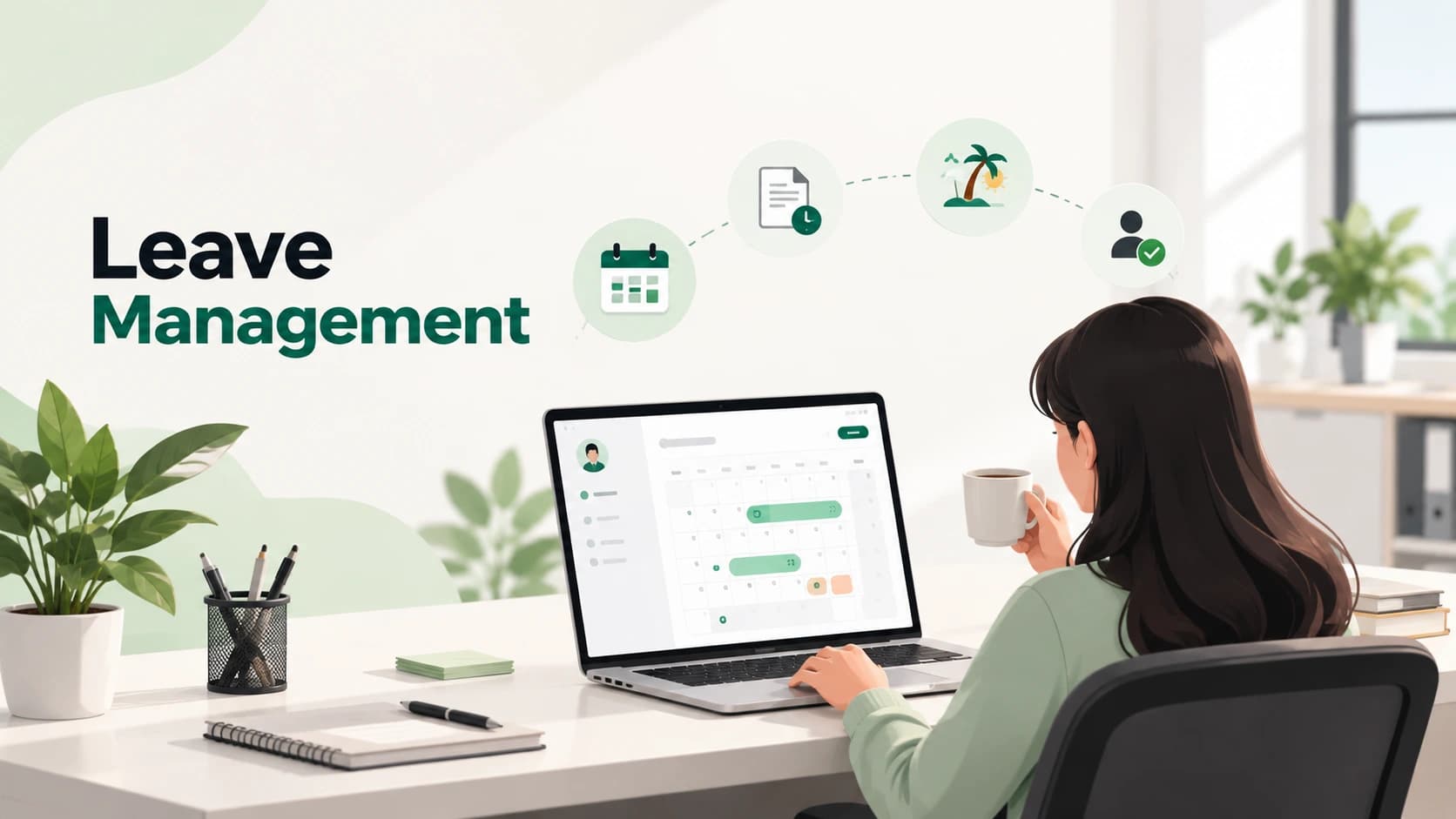
Leave management is the process of letting employees request time off, tracking how much they have left, and routing that request to the right person for approval, so a day off doesn't become a guessing game for anyone involved. Most startups think they've got this handled because it "just" involves a calendar invite and a Slack message. It doesn't stay that simple for long.
What Leave Management Actually Covers
Four moving parts, every time:
- Requesting — an employee asks for time off
- Balance tracking — how many days they've used, how many they have left
- Approval routing — getting the right manager to sign off, not just anyone who happens to be online
- Policy enforcement — making sure different leave types (sick, casual, earned, whatever your company calls them) follow their own rules instead of one blanket policy
If any of these four steps happens manually, in someone's head, or via a message that gets lost in a busy channel, you don't have leave management. You have leave hoping.
The Spreadsheet Trap (Every Startup Falls Into This)
Here's the pattern, almost word for word, at every startup between 10 and 40 people:
- Someone builds a shared spreadsheet to track days off. Feels organized.
- Two people edit it at the same time. A row disappears.
- Someone takes a day off that was never actually approved, because the request lived in a DM that got buried.
- By month six, nobody fully trusts the numbers in that spreadsheet anymore, including the person who built it.
This isn't a people problem. It's what happens when a process that depends on humans remembering things meets a team that's grown past the size where everyone remembers everything.
Why This Breaks Trust, Not Just Process
Leave balance disputes are one of the fastest ways to erode trust between a team and HR, or a team and its founder. When an employee is told they have fewer days than they thought, and nobody can produce a clean record showing why, it reads as the company being careless with something that actually matters to people. That's a bigger cost than the administrative mess itself.
What Good Leave Management Actually Looks Like
- An employee can check their own balance without asking anyone
- A request goes to exactly one correct approver, automatically
- Different leave types (sick vs. casual vs. earned) are tracked separately, not lumped into one number
- Approved leave shows up correctly in payroll without someone manually re-entering it
None of this requires an enterprise-grade HR suite. It requires the process not living in someone's memory or a spreadsheet that two people can edit at once. This is exactly what a proper leave management system handles automatically.
When to Fix This
If your team has had even one real argument about how many leave days someone has left, you're already past the point where "we'll just track it in a sheet" is working. That argument is the signal, not a one-off annoyance.
Leave policy gets more complicated once statutory rules enter the picture too, see our breakdown of the sandwich leave policy in India for one example of a rule that trips up a lot of manual trackers. And since attendance and leave are usually managed together, our companion piece, Attendance Management 101, covers the other half.
Tired of leave balance disputes nobody can clearly resolve? Meagle 360 tracks balances, approvals, and payroll sync automatically. Book a free demo →