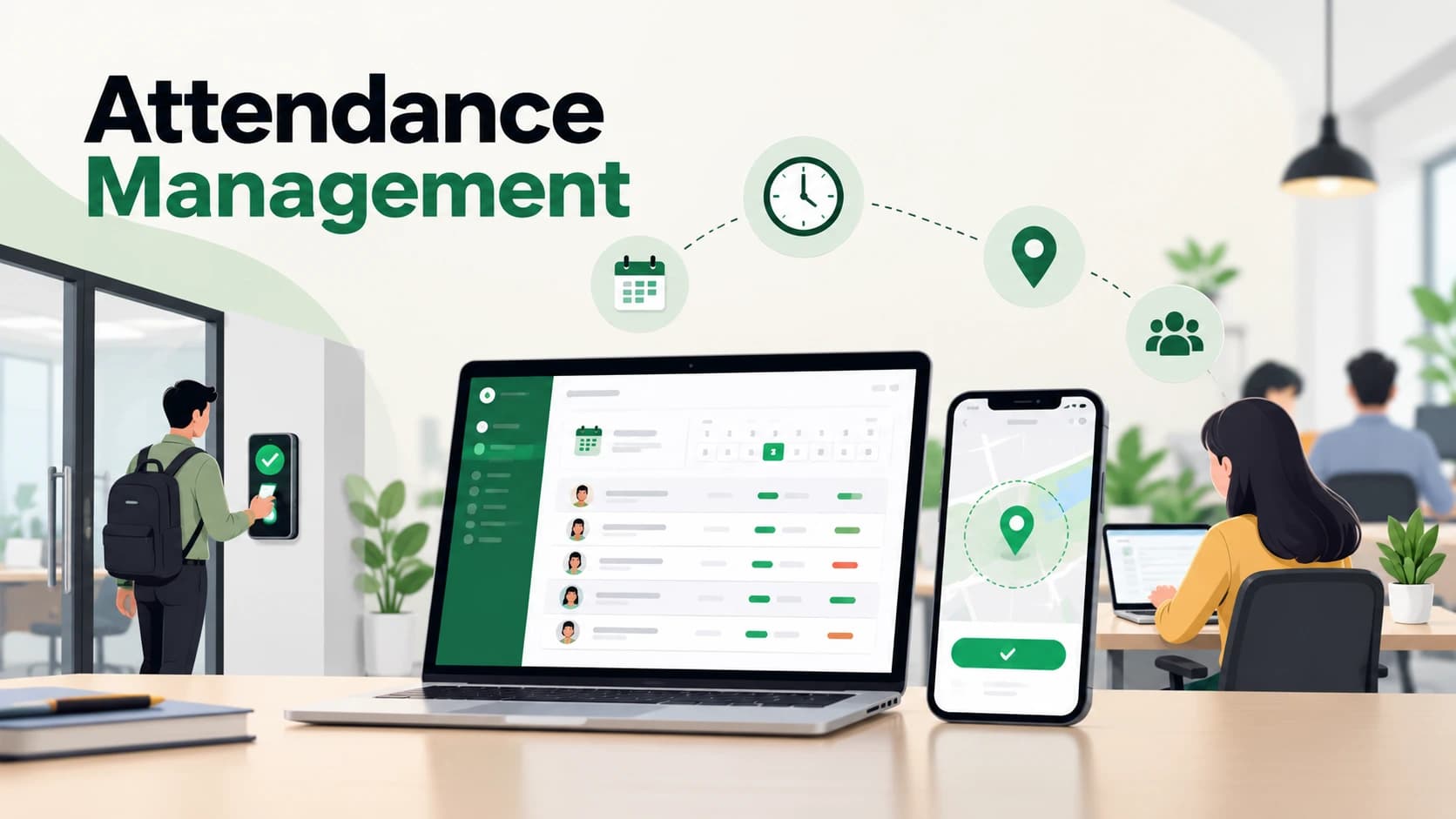
Attendance management is the process of tracking when employees work, when they don't, and making sure that data actually goes somewhere useful, mainly payroll and planning, instead of sitting in a notebook nobody checks. It sounds boring. It is boring. It's also the thing that quietly breaks first at most startups, usually right around the time a founder realizes they have no idea who was actually in the office last Tuesday.
What Attendance Management Actually Covers
Strip away the jargon and it's four things:
- Recording — who showed up, when, for how long
- Tracking exceptions — late arrivals, early leaves, no-shows
- Reporting — turning that raw data into something a manager can actually look at
- Feeding payroll — making sure unpaid absences, overtime, and late marks show up correctly in someone's salary
Any system or process that does these four things is "attendance management," whether that's a biometric scanner, a Slack check-in bot, or, more honestly, a founder manually asking "were you in yesterday?" in a DM.
Why Startups Get This Wrong (And It's Not Your Fault)
Nobody builds a startup to think about attendance tracking. For the first 5-10 people, it genuinely doesn't matter, everyone knows where everyone is. The problem shows up later, usually around 15-20 people, when:
- Nobody remembers who took an unplanned day off three weeks ago
- Payroll has to guess whether someone's absence was paid or unpaid
- A remote hire's hours become a trust exercise instead of a data point
- The founder is doing attendance reconciliation at 11pm before a payroll run
This isn't a failure of discipline. It's a scaling problem. Manual tracking works at one headcount and silently stops working at another, and most teams don't notice until payroll is already wrong.
The Three Approaches, Honestly Ranked
1. The spreadsheet (works until it doesn't)
Fine for under 10 people. Breaks down the moment more than one person needs to update it, or someone's on a different time zone, or a week gets missed and nobody notices until month-end.
2. The Slack/WhatsApp check-in (feels lightweight, isn't)
Looks modern. Is actually just a spreadsheet with extra steps, since someone still has to manually pull that data into payroll every cycle.
3. An actual attendance system (the unglamorous right answer)
Automatically logs check-ins, flags exceptions, and pushes clean data straight into payroll. The "glamour" here is zero, which is exactly why most startups put it off longer than they should. If you want to see what this actually looks like day-to-day, our attendance management system page walks through it.
When to Actually Fix This
A rough signal: if your team has crossed 15-20 people, or if more than one person has ever asked "wait, was that day paid or unpaid?", you're already past the point where manual tracking is saving you time. It's costing it, just invisibly, in founder hours and payroll corrections.
Attendance and leave are usually managed together once a team gets to this stage, so if leave requests are also starting to feel like a guessing game, see our companion piece: Leave Management 101.
Still reconciling attendance by hand before every payroll run? Meagle 360 turns this into something that runs itself. Book a free demo →