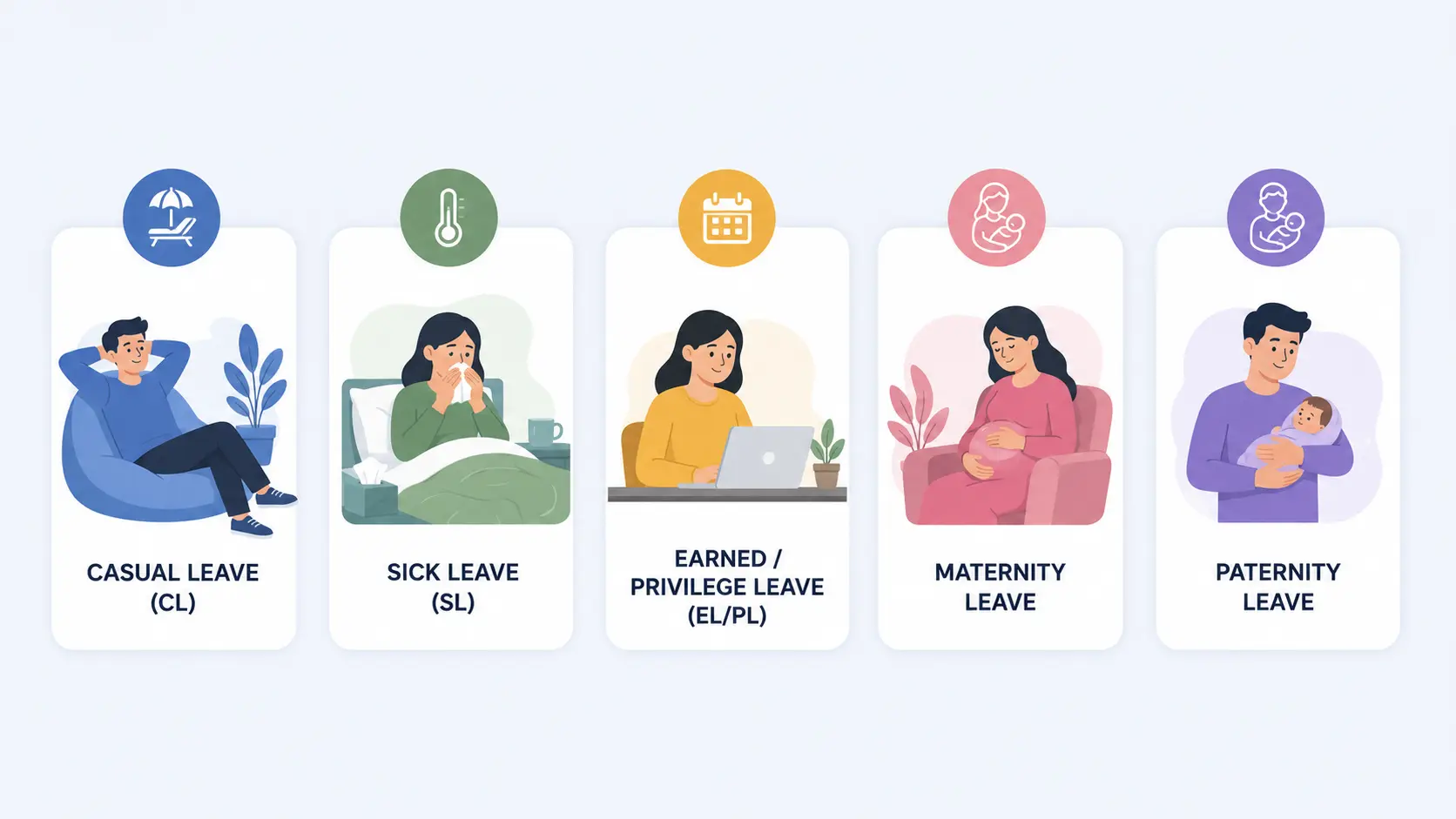
A typical leave policy in India includes Casual Leave (CL), Sick Leave (SL), Earned/Privilege Leave (EL/PL), Maternity Leave, and Paternity Leave — with maternity leave alone being centrally mandated at 26 weeks, while most other leave entitlements are set by each state's Shops and Establishments Act or company policy. Understanding each type helps employees plan time off and helps HR teams stay compliant.
Casual Leave (CL)
Short-notice leave for personal matters, typically 7–12 days per year depending on company policy and state rules. Usually cannot be carried forward to the next year.
Sick Leave (SL)
Leave taken for illness or medical reasons, typically 6–12 days per year. Some companies require a medical certificate beyond 2–3 consecutive days.
Earned Leave / Privilege Leave (EL/PL)
Leave accrued based on days worked, usually 15–18 days per year, and often carry-forwardable (sometimes with a cap) or encashable at resignation, depending on company policy and state Shops and Establishments Act rules.
Maternity Leave
26 weeks of fully paid leave for the first and second child, and 12 weeks for the third child, adoption, or surrogacy — governed by the Maternity Benefit Act, 1961, now consolidated under the Code on Social Security, 2020 (effective November 21, 2025).
Key rules:
- Applies to all establishments with 10 or more employees
- Employee must have worked at least 80 days in the 12 months before the expected delivery date
- Fully paid at the average daily wage by the employer (ESI-covered employees receive it through ESIC instead)
- PF, health insurance, and other benefits continue uninterrupted during the leave
- Adoptive mothers are entitled to 12 weeks regardless of the adopted child's age, following a 2026 Supreme Court ruling that struck down the earlier 3-month age restriction
Paternity Leave
There is currently no central law mandating paternity leave for private sector employees in India. Only Central Government employees have a statutory entitlement — 15 days under Rule 43A of the Central Civil Services (Leave) Rules, 1972, capped at two surviving children.
In the private sector:
- Roughly 14% of companies offer a formal paternity leave policy
- Where offered, it typically ranges from 5–15 days
- Some large employers go well beyond this benchmark, offering several weeks to match maternity leave
- The Code on Social Security, 2020 introduces gender-neutral "parental leave" language, but full implementation depends on state-level rules that are still being notified through 2026
Leave Without Pay (LWP) / Loss of Pay (LOP)
Unpaid leave taken once an employee has exhausted their CL/SL/EL balance. Salary is deducted proportionally for each day taken.
Comp-Off (Compensatory Off)
A day off granted in exchange for working on a holiday or weekend, usually to be availed within a defined window (commonly 30–90 days).
Bereavement Leave
Leave granted following the death of an immediate family member — not centrally mandated, but a common company policy benefit, typically 3–5 days.
Leave Types at a Glance
| Leave TypeTypical DurationMandated By | ||
| Casual Leave (CL) | 7–12 days/year | State rules / company policy |
| Sick Leave (SL) | 6–12 days/year | State rules / company policy |
| Earned Leave (EL/PL) | 15–18 days/year | State Shops & Establishments Act |
| Maternity Leave | 26 weeks (1st/2nd child) | Code on Social Security, 2020 |
| Paternity Leave | 0–15 days (private sector, discretionary) | No central mandate |
| Comp-Off | Varies | Company policy |
| Bereavement Leave | 3–5 days | Company policy |
Why Leave Policies Vary So Much Between Companies
Unlike maternity leave, which is centrally mandated, most other leave types in India fall under state-level Shops and Establishments Acts, which differ from state to state — this is why the same designation at two companies in different states can have different CL/SL/EL entitlements.
Tracking CL, SL, EL, and maternity/paternity balances across a growing team gets messy fast in spreadsheets. Reach out to our team at info@meagle360.com or WhatsApp us, or book a 15-minute demo to see leave tracking, approvals, and balances automated in one place.