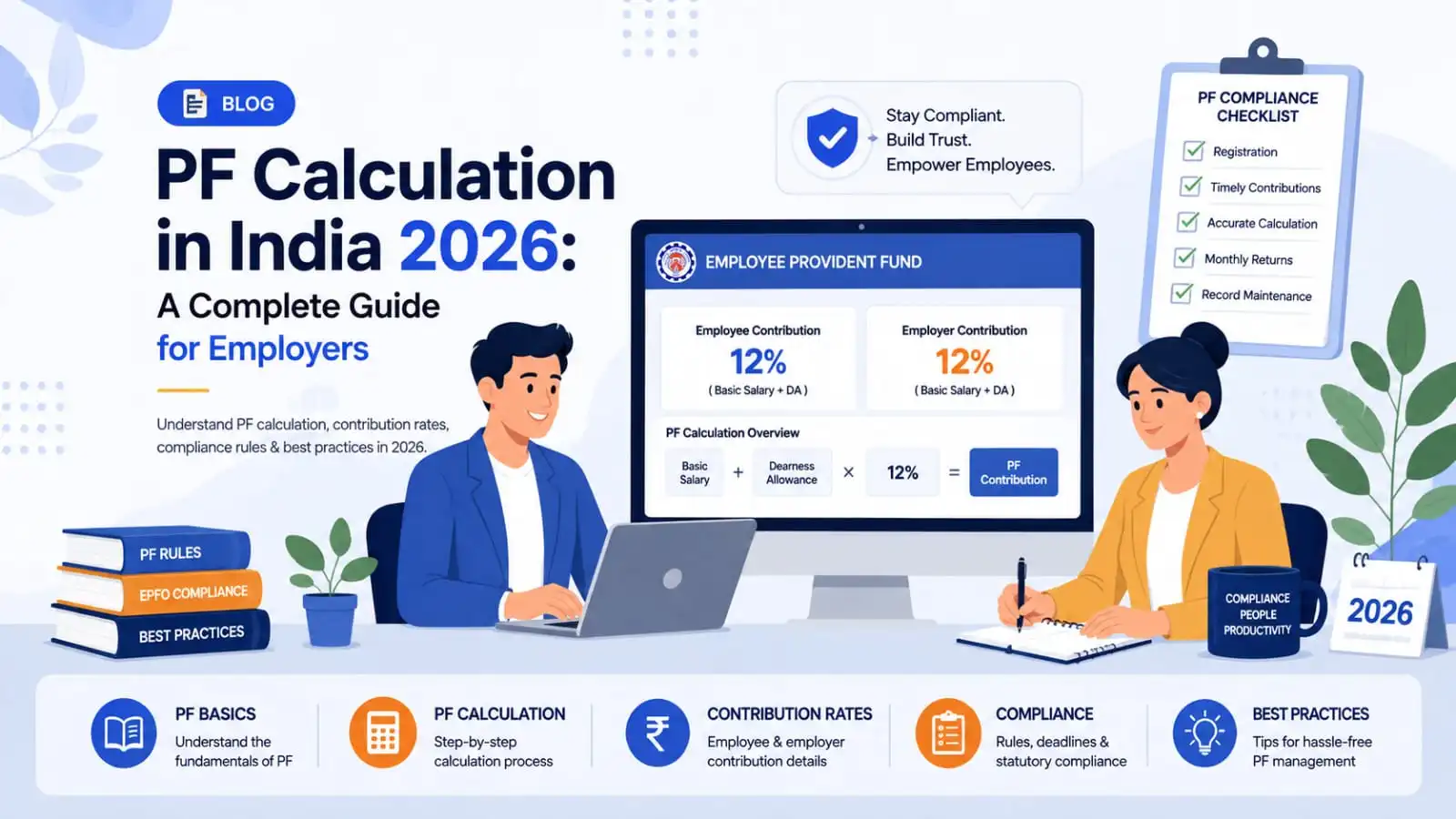
Provident Fund calculation trips up more payroll runs than almost any other statutory deduction — not because the formula is complicated, but because it has a cap most people forget about. Here's exactly how it works, with a real worked example.
What is Provident Fund (PF)?
The Employees' Provident Fund (EPF) is a retirement savings scheme where both employee and employer contribute a percentage of the employee's wages every month, held by the Employees' Provident Fund Organisation (EPFO). It's mandatory for most establishments with 20 or more employees, and the underlying contribution mechanics are set out on EPFO's official site.
Who must contribute to PF?
Any employee earning up to ₹15,000/month in "PF wages" (Basic + Dearness Allowance) is compulsorily covered. Employees earning above that can still be covered if the employer agrees, or can opt out in specific circumstances — but once someone is enrolled, contributions continue at every subsequent employer.
PF contribution rates in 2026
As of August 2026, per EPFO's published contribution rate schedule:
- Employee contribution: 12% of PF wages (Basic + DA), paid entirely into the employee's EPF account
- Employer contribution: 12% of PF wages, split into 8.33% to the Employees' Pension Scheme (EPS) and the remainder to EPF
- Employer additionally pays: 0.5% toward EDLI (Employees' Deposit Linked Insurance), capped at ₹75/employee/month, plus EPF administrative charges (minimum ₹500/month per establishment)
These rates have been unchanged since July 2019. Note that the Employees' Provident Fund Scheme, 2026 was notified in June 2026 as part of the government consolidating labour law under the Code on Social Security, 2020 — the contribution mechanics described here continue under the new scheme, but always confirm current specifics on epfindia.gov.in for your situation.
What counts as "basic salary" for PF calculation?
PF is calculated on Basic + Dearness Allowance (DA) only — not on the full CTC or gross salary. HRA, conveyance, special allowances and most other components are excluded from the PF wage base. This is exactly why "12% of salary" is a common but inaccurate way to describe the deduction: it's 12% of Basic + DA specifically.
Step-by-step PF calculation example
Take an employee with a Basic + DA of ₹30,000/month:
| ComponentCalculationAmount | ||
| Employee contribution | 12% × ₹30,000 | ₹3,600 |
| Employer — EPS share | 8.33% × ₹15,000 (capped) | ₹1,250 |
| Employer — EPF share | ₹3,600 − ₹1,250 | ₹2,350 |
| Total credited to EPF account | ₹3,600 + ₹2,350 | ₹5,950/month |
| Credited to EPS (pension, separate) | — | ₹1,250/month |
Note the EPS share is capped at 8.33% of ₹15,000 (₹1,250) even though this employee's Basic exceeds ₹15,000 — the cap applies to the EPS calculation specifically, not to the employee's own 12% contribution.
What happens when salary exceeds ₹15,000?
The employee's own 12% contribution and the employer's total 12% contribution are still calculated on the actual Basic + DA (not capped) for employees who were already PF members before crossing ₹15,000, or where the employer has agreed to contribute on the full wage. Only the EPS portion of the employer's share is capped at 8.33% of ₹15,000 — the employer's EPS contribution stays fixed at ₹1,250/month regardless of how much higher the actual Basic goes.
How payroll software handles PF automatically
The calculation above isn't hard once you know the rule — but running it correctly for every employee, every month, catching the cases where someone crosses ₹15,000 mid-year or joins with a different Basic split, is exactly the kind of repetitive work that's easy to get wrong by hand. HRMS platforms like Meagle 360's payroll module apply the current EPS cap, EDLI and admin charge rules automatically as part of each payroll run, and generate EPFO-ready contribution data without a separate manual reconciliation step.
Common PF calculation mistakes to avoid
- Calculating 12% on gross salary instead of Basic + DA
- Forgetting the 8.33% EPS cap applies to ₹15,000, not the employee's actual Basic
- Missing the employer's additional EDLI and admin charge outgo when budgeting total cost-to-company
- Not updating contributions when an employee's Basic changes mid-year (increment, promotion, revision)
- Assuming PF rates have changed without checking EPFO's current notification first
Want PF handled automatically instead of by hand every month? Reach out to our team at info@meagle360.com or +91 80773 13241, or book a 15-minute demo to see it in action.